Ylang-Ylang: Narcotic Floral, Green Paradox, and Accord Construction
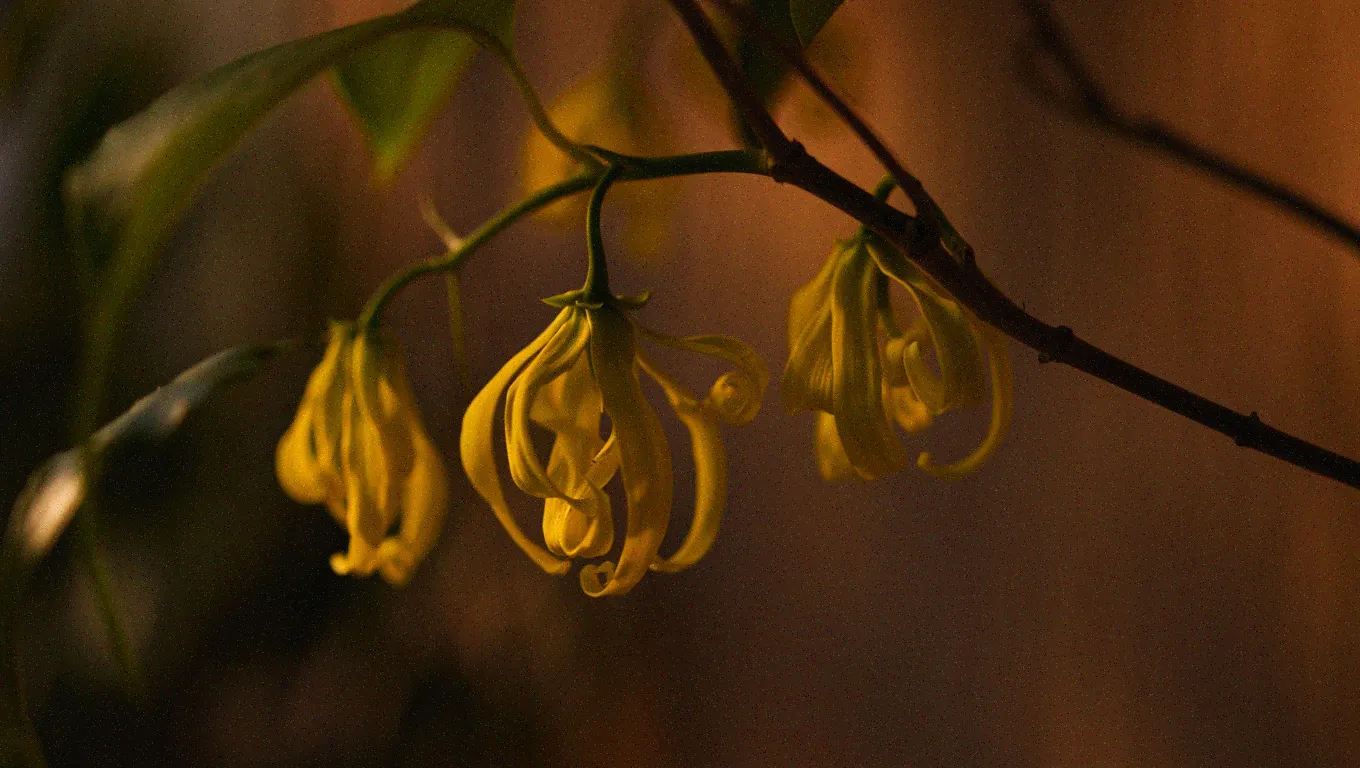
Ylang-ylang is one of the few natural materials that smells, on first encounter, like a finished perfume. It arrives complete — sweet and dark, creamy and sharp, tropical and somehow green, fruity and animalic, spiced and balsamic — as though an invisible hand has already composed a fragrance and poured it into a single flower. This is both its gift and its difficulty. To work with ylang-ylang is to negotiate with something that already has opinions about what it wants to be. Over a hundred identified molecules conspire in its essential oil and absolute, creating an olfactory experience that resists simple categorization and rewards patient study. Present in an estimated 40% of quality perfume creations — from Chanel No. 5, where Ernest Beaux used it to tether champagne-like aldehydes, to Tom Ford’s sun-drenched Soleil Blanc — ylang-ylang remains one of the perfumer’s most indispensable and paradoxical raw materials.
What follows is a working perfumer’s investigation into what makes this flower tick: its molecular anatomy, its surprising green dimension, the modern synthetics that echo its character, and a professional substitution formula for those moments when the absolute’s price or IFRA constraints demand another path.
The molecular theatre behind ylang-ylang’s narcotic spell
The essential oil of Cananga odorata contains over 109 identified compounds, and the composition shifts dramatically across the distillation fractions. Extra Superior — the first, most volatile, most prized cut — is rich in the odoriferous phenylpropanoids and esters that give ylang-ylang its recognizable signature. The later fractions (Grades I through III) progressively accumulate sesquiterpene hydrocarbons like germacrene D and β-caryophyllene, eventually comprising over 70% of Grade III — useful for soap perfumery, less so for fine fragrance. The absolute, extracted via hexane from the concrete, takes a different route entirely: it completely lacks the heavy sesquiterpenes, which appear to be thermal artifacts of distillation rather than true constituents of the living flower. This makes the absolute lighter, more uniform, and arguably more faithful to what one smells standing beneath a cananga tree at dusk.
The backbone of ylang-ylang’s sweet floral character is benzyl acetate (CAS 140-11-4), present at 14–25% in Extra grades. It provides the jasmine-like, slightly banana-fruity sweetness — what Arctander might have called the “simple” part of ylang’s complexity. But benzyl acetate alone produces something thin and one-dimensional, a sketch rather than a painting. The depth arrives from elsewhere.
Linalool (CAS 78-70-6, specifically the laevo-rotatory R-form) constitutes 8–24% of the Extra fraction, often the single largest component. It gives ylang-ylang its airy, citrus-tinged, lavender-edged lift — the part that breathes and diffuses, that carries the scent outward from skin. Alongside it, geranyl acetate (CAS 105-87-3, at 2–14%) and traces of geraniol (CAS 106-24-1) weave in a rosy-waxy fruitiness that prevents ylang from reading as merely sugary.
Then comes the dark side. p-Cresyl methyl ether — also called para-methylanisole (CAS 104-93-8) — is present at a remarkable 5–16% in Extra, making it one of the oil’s largest constituents. It is pungent, phenolic, smoky, faintly medicinal, and utterly characteristic. This molecule is what associates ylang-ylang with narcissus; it gives the scent its sharp, slightly camphoraceous bite. In combination with traces of p-cresol itself (CAS 106-44-5, at a mere 0.1–0.3%), the phenolic dimension becomes the engine of ylang’s narcotic tension. p-Cresol is disproportionately powerful — animalic, barnyard, faintly fecal — and at this concentration it adds exactly the carnal, dirty-sweet undertone that separates a narcotic floral from a merely pretty one.
The spicy dimension comes from eugenol (CAS 97-53-0, ~0.2–4%) and isoeugenol (CAS 97-54-1, ~0.2%), providing clove-carnation warmth. Isoeugenol was historically first isolated from the cananga tree itself — a fact that underscores how deeply this spicy character belongs to ylang’s identity. The balsamic foundation rests on benzyl benzoate (CAS 120-51-4, at 3–15%), which functions as a quiet, warm fixative that holds everything together and extends the drydown. Benzyl salicylate (CAS 118-58-1, at 1.5–3.5%) adds the sunlit, tanning-lotion warmth that makes ylang read as distinctly tropical and solar.
In the drydown, farnesol (CAS 4602-84-0, at 0.8–2.1%) and traces of nerolidol (CAS 7212-44-4) create the musky, skin-like, linden-scented whisper that is ylang’s final word on a blotter strip — soft, intimate, almost imperceptible but essential. These sesquiterpene alcohols don’t project from skin, but they provide the subliminal “body” sensation that makes ylang read as warm and alive rather than merely sweet.
Why “narcotic” is a compliment
The word narcotique in French perfumery carries none of the clinical dread it suggests in English. It derives from the Greek narke — the same root as narcissus — and describes a scent that overwhelms pleasurably, inducing a kind of olfactory trance. In ylang-ylang, this narcotic character arises from a specific tension: the contrast between sweetness and decay, between the creamy and the carnal. The benzyl acetate sings a lullaby; the p-cresol whispers something unspeakable. The linalool lifts the spirit; the eugenol grounds it in spice and earth. This is the Eros-and-Thanatos dynamic that all great narcotic florals share — jasmine, tuberose, gardenia — but in ylang-ylang it plays out with a uniquely phenolic edge rather than the indolic one more familiar from jasmine.
Traces of indole (CAS 120-72-9, <0.05%) do appear in ylang-ylang, along with whispers of methyl anthranilate, but these are supporting actors. Ylang’s darkness is primarily phenolic — smoky, medicinal, rubber-like — rather than the mothball-and-jasmine indolic darkness of tuberose. This distinction matters for the perfumer: ylang-ylang’s narcotic quality has a sharper, more metallic edge, a quality Arctander captured when he described the absolute’s “unusual power in its top note” fading “very slowly and most elegantly.”
The mystery, ultimately, is irreducible. As one working perfumer observed: “In the case of ylang, I do not really think any one of the single components is the source of the beauty. This is a case where the mixture and how it comes together is greater than just the sum of its parts.” More than a hundred voices singing simultaneously — major constituents and trace compounds, volatile esters and heavy sesquiterpenes, the specific chirality of the natural (−)-linalool, the nonvolatile waxes retained in the absolute — create a polyphonic complexity that no simple reconstruction fully captures.
The green paradox: tropical sweetness with an unexpected vegetal soul
There is something genuinely strange about ylang-ylang’s greenness. Here is a flower that reads as quintessentially tropical — creamy, sweet, narcotic, lush — and yet carries a persistent green quality that shouldn’t logically be there. This is not the brittle, bitter greenness of galbanum or the dewy crispness of violet leaf. It is warmer, waxier, more medicinal — a greenness that seems to emanate from inside the sweetness rather than standing apart from it. Understanding this paradox requires looking at specific molecules and, more importantly, at how they interact.
The primary architect of ylang-ylang’s green facet is methyl benzoate (CAS 93-58-3), present at 4.5–8% in Extra. This compound brings a distinctive wintergreen-leafy-minty freshness — not the green of a crushed stem but the green of something aromatic and slightly medicinal, like a sprig of wintergreen held against warm skin. Methyl benzoate is also found in tuberose, which shares this particular green-medicinal dimension with ylang. Its presence in both flowers helps explain why the two materials, despite their different overall characters, sometimes rhyme at an unexpected frequency.
Reinforcing this, methyl salicylate appears in small amounts, doubling down on the wintergreen impression. The sesquiterpene hydrocarbons — germacrene D (9–15% in Extra), β-caryophyllene (2–6%), (E,E)-α-farnesene (2–6%) — contribute a woody-green vegetal depth that accumulates in the later fractions but is present even in Extra. And p-cresyl methyl ether itself, that defining phenolic note, softens as it dries into something that several analysts describe as greener, more marigold-like — a phenolic-to-vegetal transition that adds another layer to the paradox.
How ylang-ylang’s green compares with the classical palette
The traditional green notes in perfumery — galbanum (the resinous, dark, undergrowth green of Ferula species), violet leaf (the cucumber-leather-sulfurous green of Viola odorata leaves), and cis-3-hexenol (the simple fresh-cut-grass molecule) — create their effect through sharp, bitter, temperate-climate freshness. These are the greens of a European garden in spring rain. Ylang-ylang’s greenness is something altogether different: a humid, waxy, tropical-medicinal green, warm rather than cool, embedded within sweetness rather than opposing it. If galbanum is a crumpled leaf and violet leaf is a snapped stem, ylang’s green is the waxy surface of a tropical leaf in afternoon heat — aromatic, slightly camphoraceous, alive.
This means ylang-ylang fundamentally resists classification as a “green floral” in the way that Chanel No. 19, Balmain Vent Vert, or Cristalle embody that category. Those fragrances rely on galbanum and petitgrain for crisp, structured greenness. Ylang is a narcotic floral with a paradoxical green undercurrent — not a green floral with narcotic tendencies. The distinction matters for composition: ylang’s greenness emerges as a secondary overtone, not a primary color. It whispers rather than declares.
Botanical cousins and olfactory neighbors
Placing ylang-ylang alongside related tropical florals illuminates its unique position. Champaca (Magnolia champaca) is often cited as ylang-ylang’s closest botanical relative, and there is truth here — both belong to the order Magnoliales. They share certain ancestral aromatic traits: benzyl esters, terpene-rich oils, indolic compounds in the flowers, and methyl benzoate. But champaca’s chemistry diverges sharply. Its absolute is dominated by phenylethyl alcohol (25–34%) and indole (up to 12%) — making it far more rosy and intensely indolic than ylang. Where ylang is phenolic-creamy-green, champaca is rosy-indolic-peppery. They are cousins who took different paths at a very early fork.
Tuberose (Polianthes tuberosa) is the closest olfactory analogue in the narcotic register. Both share methyl benzoate, both carry indolic-narcotic depth, and both create that distinctive cream-and-darkness tension. But tuberose is heavier on the lactonic dimension — coconut-milk creaminess, beeswax sweetness, a buttery quality from butyric acid — where ylang is fruitier and more phenolic. Significantly, ylang is itself used as a building block in tuberose accords — indicating that perfumers regard it as containing a subset of tuberose’s character rather than competing with it.
Frangipani (Plumeria) shares ylang’s tropical identity and several chemical constituents — benzyl benzoate, farnesol, linalool, benzyl salicylate — but is lighter, more peachy-almondy, with a soft aqueous greenness. Frangipani is the watercolor to ylang’s oil painting. And magnolia, dominated by linalool with creamy-citrus facets, is more transparent and less narcotic, sharing ylang’s waxy quality but lacking its phenolic darkness and green-medicinal edge.
Mango leaves offer an interesting counterpoint. The leaf absolute delivers an authentically tropical green that is purely vegetal, dominated by (Z)-3-hexen-1-ol acetate and terpenes. It is green-fruity-leathery, with none of ylang’s narcotic floral character. If ylang-ylang’s greenness is the smell of a flower that happens to be green, mango leaf is the smell of green that happens to be tropical. The two materials can work together in compositions seeking a convincing tropical-garden atmosphere, but they represent opposite ends of the green-floral spectrum.
Modern aromachemicals that speak ylang-ylang’s language
When the absolute is too expensive, the IFRA ceiling too low, or the brief demands a specific facet of ylang’s character without the whole orchestra, perfumers turn to synthetics. The challenge is that ylang is not a single idea but a conversation between many molecules — and synthetic reconstruction requires understanding which voices to include and in what proportion.
Benzyl acetate (CAS 140-11-4) remains the indispensable workhorse. It is unrestricted by IFRA, inexpensive, and provides the sweet-floral-jasmine body that constitutes ylang’s largest olfactory impression. Synthetic benzyl acetate is nature-identical but can carry slight chemical off-notes compared to the natural isolate obtained from ylang-ylang itself. Fraterworks’ benzyl acetate ex ylang-ylang — a natural isolate from Payan Bertrand — is prized by perfumers who find it finer and more complete than the synthetic. Typical usage in a ylang accord runs 15–25% of the base.
p-Cresyl methyl ether (CAS 104-93-8) is the character molecule — the ingredient that makes a ylang accord smell like ylang rather than generic jasmine. At 5–10% of an accord, it introduces the sharp, phenolic, powdery-camphoraceous quality that is ylang’s most recognizable signature. It requires careful handling: alone it is pungent and medicinal, but in context it is the ingredient that makes a blend snap into focus. For the darker, more animalic dimension, paracresyl phenylacetate (CAS 101-94-0) offers a gentler, more overtly floral version of the p-cresol effect — sweet narcotic bouquet qualities of narcissus and ylang with a phenolic-honey undertone. It can be used at 1–3% in floral accords, making it more practical than p-cresyl acetate (CAS 140-39-6), which is harsh at anything above trace levels and typically applied as a 10% dilution at 0.05–0.5%.
Hedione (methyl dihydrojasmonate, CAS 24851-98-7) doesn’t occur in ylang-ylang, but it is arguably the most important synthetic for creating the effect of ylang in modern perfumery. Its transparent, radiant, jasmine-like luminosity adds the diffusive tropical shimmer that makes ylang compositions feel sun-drenched and expansive. Édouard Fléchier used it alongside ylang-ylang in Initio Psychedelic Love specifically to amplify that narcotic-radiant quality. At 5–15% of an accord, hedione lifts and aerates the heavier components. Hedione HC (high-cis isomer) is even more diffusive, with a jasmine-tea transparency that is more expensive but more elegant. Dihydrojasmone (CAS 1128-08-1) contributes a richer, celery-nutty-fruity dimension, and methyl jasmonate (CAS 39924-52-2) — profound and oily-green at trace levels — adds the naturalistic living-flower quality that can push a synthetic accord closer to something organic.
For the spicy facet, eugenol (CAS 97-53-0) and isoeugenol (CAS 97-54-1) are the natural choices, but IFRA constraints bite hard. Eugenol is restricted to 2.5% in Category 4 finished product — workable at the trace levels ylang requires. Isoeugenol, however, is limited to a mere 0.11% in finished product, making it one of the most heavily restricted common fragrance materials. In practice, this means isoeugenol can appear only at vanishing concentrations in a modern ylang accord. Fraterworks has developed an “Isoeugenol Replacer” base for exactly this problem. Cinnamyl acetate (CAS 103-54-8), present at 4–6% in natural ylang Extra, provides the spicy-balsamic warmth without the same regulatory burden and is an excellent substitute for part of the isoeugenol effect.
Indole (CAS 120-72-9) is the molecule of duality. Pure, it is mothballs and naphthalene. At extreme dilution — 0.02–0.1% of a compound, pre-diluted to 10% in DPG for handling — it becomes radiant, narcotic, alive. In ylang accords, indole deepens the white-floral narcotic character without dragging the composition into jasmine territory. It is not ylang’s primary darkness (that belongs to the phenolics), but it adds the subliminal sense of biological warmth. Unrestricted by IFRA but requiring careful dosing — a 10× error can catastrophically shift a composition from seductive to unwearable.
Iso E Super (CAS 54464-57-2) and Ambroxan (CAS 6790-58-5) function not as ylang-specific materials but as modern infrastructure. Iso E Super, at 2–5% of an accord, provides a velvety, woody transparency that smooths rough edges and extends projection. Ambroxan — which should never exceed 1% of fragrance concentrate — adds an amber-warm, skin-like radiance that is particularly effective in the drydown, where it can mimic the intimate musky quality that farnesol and nerolidol provide in the natural oil.
For the rosy-diffusive dimension, linalool (CAS 78-70-6) and geranyl acetate (CAS 105-87-3) are used at their natural proportions — 10–15% and 3–8% respectively in the accord. Linalool requires allergen labeling in the EU but has no IFRA use limit. Methyl benzoate (CAS 93-58-3), at 5–8%, brings the green-fruity wintergreen character that is so crucial to ylang’s paradoxical freshness. Benzyl benzoate (CAS 120-51-4) and benzyl salicylate (CAS 118-58-1) provide the balsamic fixative foundation, though benzyl salicylate has been significantly restricted in recent IFRA amendments and must be monitored carefully.
A few commercially available specialty bases deserve mention. Robertet’s Lisylang is a well-known ylang reconstruction used by professional perfumers. Fraterworks’ Ylang Impéria is marketed specifically as “a synthetic replacer for ylang-ylang oil that can be used at much higher quantities under IFRA guidelines” — a direct solution for the regulatory ceiling problem. And for the perfumer who wants to split the difference, natural ylang-ylang oil can be used to the IFRA maximum of 0.73% in Category 4 finished product and then supplemented with synthetic materials to reach the desired intensity — a hybrid approach that many professionals prefer.
A working formula: ylang-ylang absolute substitution
The following formula is designed to replicate the multifaceted character of ylang-ylang absolute using professional-grade synthetic and isolate materials. At approximately $1,600–1,800 per kilogram for quality absolute — and with IFRA limiting natural ylang to 0.73% in fine fragrance finished product due to methyl eugenol content — a convincing substitution has both economic and regulatory justification.
This is a fragrance concentrate formula expressed in parts per thousand. It is designed to be used at 5–15% in an alcoholic solution. Each component earns its place.
Formula: Ylang-Ylang Absolute Reconstruction
Benzyl acetate (CAS 140-11-4).................. 220
Sweet floral-jasmine body; primary ester backbone
Linalool (CAS 78-70-6)......................... 162
Airy floral diffusion; citrus-lavender lift
p-Cresyl methyl ether (CAS 104-93-8)........... 90
Ylang identity; phenolic-smoky character note
Hedione (CAS 24851-98-7)....................... 80
Radiance; transparent tropical jasmine shimmer
Benzyl benzoate (CAS 120-51-4)................. 75
Balsamic fixative; warm canvas for the blend
Methyl benzoate (CAS 93-58-3).................. 65
Green-fruity wintergreen; the paradoxical freshness
Geranyl acetate (CAS 105-87-3)................. 60
Rosy-waxy diffusion; fruity body
Cinnamyl acetate trans (CAS 103-54-8).......... 40
Spicy-balsamic warmth; replaces restricted isoeugenol
Benzyl salicylate (CAS 118-58-1)............... 35
Solar balsamic undertone; sunlit warmth
Iso E Super (CAS 54464-57-2)................... 30
Velvety woody blender; extends projection
β-Caryophyllene (CAS 87-44-5).................. 25
Woody-spicy depth; sesquiterpene anchor
Paracresyl phenylacetate 10% DPG (CAS 101-94-0) 25
Dark narcotic-phenolic depth; narcissus-honey undertone
α-Isomethyl ionone (CAS 127-51-5).............. 20
Powdery violet smoothness; rounds the composition
Eugenol (CAS 97-53-0).......................... 15
Clove-spice accent; warm spicy anchor
Prenyl acetate (CAS 1191-16-8)................. 15
Fruity-banana top note; fresh green-fruity lift
Farnesol (CAS 4602-84-0)....................... 15
Musky skin-like drydown; linden-muguet base
Geraniol (CAS 106-24-1)........................ 10
Rosy highlights; sweet floral facets
Indole 10% DPG (CAS 120-72-9).................. 10
Narcotic white-floral darkness; biological warmth
Ambroxan (CAS 6790-58-5)....................... 8
Warm amber fixative; skin-like radiance in drydown
                                                ----
TOTAL.......................................... 1000
Rationale and usage notes
The formula’s center of gravity is the benzyl acetate / linalool / p-cresyl methyl ether triad, which together comprises 472 parts — nearly half the formula. This mirrors the natural oil, where these three constituents collectively represent 30–50% of the Extra fraction. Benzyl acetate provides the sweet-floral canvas, linalool the aerial freshness, and p-cresyl methyl ether the unmistakable ylang signature. Without any one of these three, the accord collapses into something else.
Hedione at 80 parts (8%) does not appear in natural ylang but is the formula’s secret weapon. It introduces the radiant, transparent, sun-warmed quality that makes the difference between a reconstruction that reads as a collection of chemicals and one that reads as a tropical flower. Think of it as lighting: it doesn’t change what’s in the room, but it changes how you see everything.
The methyl benzoate (65 parts) is critical for the green paradox. Without it, the accord loses its wintergreen-aromatic freshness and becomes merely sweet. This is the ingredient that most reconstructions underweight, and its absence is why many ylang bases smell like a heavy jasmine rather than like ylang-ylang.
Paracresyl phenylacetate (25 parts at 10% dilution = 2.5 parts active) provides the dark narcotic-phenolic depth without the harshness of p-cresol or p-cresyl acetate at working concentrations. It carries a narcissus-honey-ylang character that is more manageable than the parent phenol. Indole (10 parts at 10% dilution = 1 part active) adds the subliminal biological warmth — the sense that this is a living flower rather than a construction of esters and alcohols.
Eugenol at 15 parts (1.5%) provides the spicy-clove facet within IFRA Category 4 limits. At a 10% concentration in the finished product, this contributes 0.15% eugenol — well within the 2.5% allowance. Cinnamyl acetate at 40 parts reinforces the spicy-balsamic character and partly substitutes for isoeugenol, which has been omitted entirely due to its severe restriction at 0.11% in finished product.
Ambroxan at 8 parts (0.8%) sits safely below the 1% ceiling. It appears primarily in the drydown, where it extends the warm, musky, skin-like quality that farnesol provides at its lower concentration in the formula.
Pre-dilution requirements
Three materials in this formula require mandatory pre-dilution before weighing. Paracresyl phenylacetate is listed at its 10% dilution in dipropylene glycol (DPG), meaning 25 parts of the dilution contribute 2.5 parts of active material. Indole is also at 10% in DPG, contributing 1 part active from 10 parts solution. Both materials are too potent and too low in required quantity to weigh accurately at full concentration. If preferred, indole may be diluted to 1% for even finer control. Eugenol can be used neat at this level but benefits from 50% dilution in DPG for dosing precision during trial batches.
Blending sequence and maturation
Begin with the fixative layer: weigh benzyl benzoate, benzyl salicylate, and Iso E Super into a clean glass beaker. Add Ambroxan and farnesol. Allow these to meld for several minutes. Next, add the heart: benzyl acetate, p-cresyl methyl ether, methyl benzoate, geranyl acetate, cinnamyl acetate, α-isomethyl ionone, β-caryophyllene, and geraniol. Stir gently. Then add the diffusive elements: linalool, hedione, and prenyl acetate. Finally, introduce the trace materials: paracresyl phenylacetate solution, eugenol, and indole solution. Stir thoroughly.
The concentrate must mature. Fresh, it will smell disjointed — the phenolics harsh, the esters raw, the indole uncomfortably prominent. After one week, the blend begins to cohere; the p-cresyl methyl ether softens and integrates with the benzyl acetate. After three to four weeks, the formula reaches working quality — the spicy, balsamic, and narcotic dimensions begin to speak as a single voice. At eight weeks, the drydown fully develops, and the farnesol–Ambroxan base acquires the intimate, skin-like quality of natural ylang absolute. Full maturation may continue improving the blend for up to three months.
Adjustments for specific applications
For a brighter, more Extra-like character, increase prenyl acetate to 25 parts and add 5 parts of methyl salicylate for enhanced wintergreen freshness. For a darker, more absolute-like reading, increase paracresyl phenylacetate solution to 35 parts and add 5 parts of gamma-octalactone (CAS 104-50-7) for creamy-coconut depth. For a more diffusive, modern interpretation, increase hedione to 120 parts at the expense of benzyl benzoate. If natural materials are available, this formula also functions as a scaffold for hybrid use: add natural ylang-ylang Extra or absolute to the IFRA maximum alongside this base, and the result will have a naturalistic richness that pure synthetics cannot achieve alone.
Conclusion: working with a material that already knows what it wants
Ylang-ylang’s enduring difficulty — and enduring fascination — lies in its completeness. Most raw materials offer a single idea, or perhaps two, and the perfumer’s task is additive: building complexity from simplicity. Ylang-ylang reverses this. It arrives as a crowd, and the perfumer’s task is curatorial: selecting which voices to amplify, which to suppress, which to redirect. Its narcotic quality is not merely indolic darkness or phenolic tension but the dynamic interplay between them — sweetness contesting with decay, cream against smoke, tropical warmth against that strange, persistent, wintergreen-medicinal green.
The green paradox is perhaps the least understood and most underutilized dimension of ylang-ylang. While the narcotic character gets the attention, it is the green quality — that methyl benzoate–driven freshness, warm and waxy rather than cool and bitter — that prevents ylang from becoming cloying. It is the reason ylang works in compositions as structurally diverse as aldehydic florals, leathery chypres, and transparent musky veils. The green is what makes the sweet bearable, and the sweet is what makes the green invisible.
For the working perfumer, the practical takeaway is this: respect both sides of ylang-ylang’s personality. A reconstruction that captures only the sweet-floral ester character is a jasmine base, not a ylang base. A reconstruction that captures only the phenolic-animalic darkness is a narcissus base. It is the combination — the clean with the dirty, the green with the sweet, the airy with the heavy — that creates the material’s singular identity. The formula above is one path; there are others. But any path that reaches ylang-ylang must pass through all of its contradictions.