Suede Leather in Perfumery: Building a Modern Transparent Leather Accord
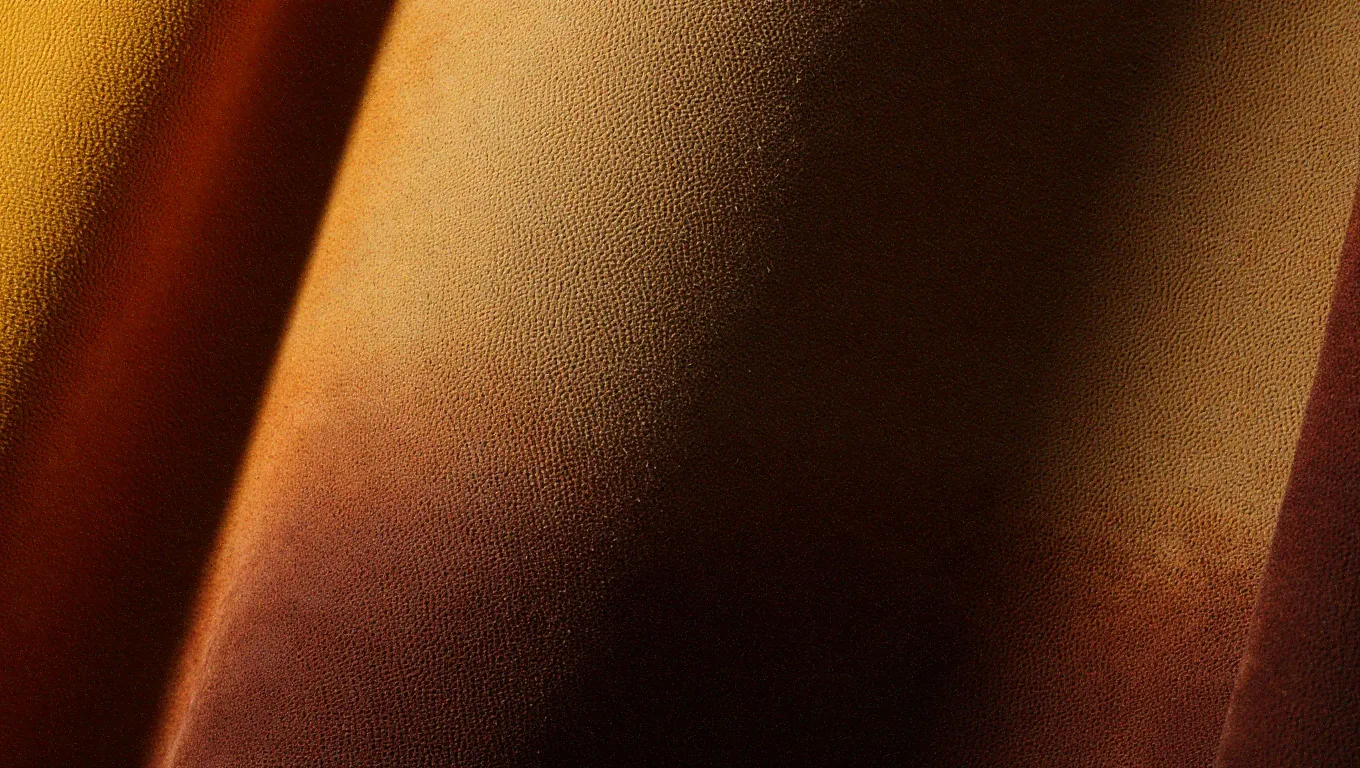
The soft, velvety scent of suede has quietly displaced every other leather type in modern perfumery. Unlike the smoky brutality of Russian leather or the sharp green bite of galanterie accords, suede leather delivers something paradoxical: density without heaviness, presence without aggression, and a tactile quality you can sense at arm’s length. This is leather reimagined as texture rather than drama — powdery but not dusty, resinous but not sweet, radiating the warmth of skin beneath brushed hide. For the working perfumer, mastering the suede accord means gaining access to one of the most versatile tools in the modern palette: a material complex that enriches orientals, deepens florals, grounds musks, and lends quiet authority to virtually any composition.
What makes the suede effect so compelling — and so elusive — is its proportional logic. The trick is not layering dozens of materials at equal weight. It is a high presence of distinctly leathery notes supported by restrained powdery, musky, and resinous elements. The leather must lead. Everything else must serve it without competing. Get this ratio wrong, and you land in either iris-heavy cosmetic territory or musk-smothered cleanliness. Get it right, and the result has that unmistakable quality: the olfactory equivalent of running your thumb across fine nubuck.
How suede emerged from the wreckage of classical leather
Classical leather in perfumery was built from materials that genuinely smelled of tanneries. Birch tar oil — obtained by pyrolysis of birch bark — produced the intensely smoky, phenolic character of Russian yuft leather. Castoreum contributed animal warmth. Cade oil added tarry darkness. Isobutyl quinoline brought a sharp, chemical bite. Together, these materials created fragrances of enormous power: Chanel’s Cuir de Russie (1924), Piguet’s Bandit (1944), Grès Cabochard (1949). But power was their limitation. These compositions demanded the room. They could not share space gracefully.
The shift began with regulation and accelerated with taste. Crude birch tar was prohibited by IFRA as a Category 1 carcinogen. Crude cade oil followed. Natural castoreum became scarce, ethically fraught, and prohibitively expensive. Oakmoss restrictions devastated the chypre family that had long supported leather compositions. By the early 2000s, the traditional leather palette had been largely dismantled.
What replaced it was not a lesser version of the same idea. It was a fundamentally different aesthetic. Perfumers stopped trying to smell like a saddle workshop and started asking: what does leather feel like? The answer — soft, warm, velvety, intimate — pointed toward suede. When Christopher Sheldrake released Daim Blond for Serge Lutens in 2004, he made this answer definitive. The composition married apricot kernel’s fuzzy-skin texture with iris powder and a restrained suede accord, creating a synesthetic experience where you felt the brushed hide through your nose. It was luminous where Russian leather was dark, pastoral where classical compositions were industrial. Reviewers called it “a spartan oriental” — an oxymoron that captured its spare, textural innovation.
Guerlain’s Cuir Beluga (2005, Olivier Polge) took a different route to the same destination, wrapping suede in vanilla and aldehydes. Polge reportedly used aldehydes specifically as buffers to soften Suederal’s dry edge — a technique worth noting. Helmut Lang’s Cuiron (2002, Françoise Caron) had arrived even earlier, presenting suede as something minimalist and clean, more conceptual art than perfumery tradition. Together, these three compositions established the blueprint: suede is leather with the volume turned down and the resolution turned up.
Today, suede functions less as a standalone note and more as a textural modifier that works across every fragrance family. Narciso Rodriguez has systematically woven it through an entire musk-centered line. Bottega Veneta used it to define a luxury house’s complete olfactive identity. In chypres, suede replaces lost oakmoss depth. In orientals, it adds grip without competing with amber. In florals, it creates sophisticated contrast. This versatility is precisely why mastering it matters.
The molecules that make suede feel like suede
Building a suede accord requires understanding what each material contributes to the sensation of brushed leather — not just its smell in isolation, but its behavior in a blend.
Suederal LT (IFF) is the most direct suede material available. It is not a single molecule but a proprietary blend of hydrogenated rosinic and resinic acid methyl esters, obtained hemisynthetically. On a blotter, it reads as dry suede with warm tobacco undertones, a smoky-phenolic whisper, and refined castoreum-like warmth. The manufacturer describes it as “a leather note that is both animal and velvet.” In practice, Suederal is deceptively powerful — what smells restrained from the bottle can dominate a blend quickly. Start at 0.5–5% and increase with caution. Its most significant technical limitation is poor alcohol miscibility: pre-dissolve in benzyl benzoate or dipropylene glycol, or risk phase separation that ruins the batch.
Safraleine (Givaudan) is arguably the most important modern molecule for suede. Chemically an indenone derivative, it delivers warm, powerful, leathery and tobacco facets with a complexity that reveals rose-ketone floral undertones and subtle spice. Perfumer Arcadi Boix Camps wrote that Safraleine imparts “subtleness, delicacy, refinement, intricacy, velvetiness and great class wherever it is used.” Its tenacity is extraordinary — 164+ hours on blotter at 10% dilution. Use it at 0.1–0.5% for a soft saffron-leather warmth; above 1%, the leather character becomes pronounced; above 3%, it flattens everything around it. This molecule rewards precision and punishes heavy hands.
Iso E Super (IFF) provides the transparent radiance that defines the suede aesthetic. Sometimes called “the ghost molecule,” it registers as warm, woody, cedarlike, with aspects of ambergris and a slight phenolic whisper — yet on its own it can seem nearly odorless. In a blend, its contribution is unmistakable: a velvety, diffusive presence that smooths edges and creates the perception of air around the leather. It does not smell like suede. It makes everything else smell more like suede. Use generously — 5–15% — as the structural backbone of the accord.
Isoraldeine 70 is the critical powdery-suede bridge. Where the 95 grade delivers pure violet finesse, the 70 grade — containing approximately 30% additional methyl ionone isomers — carries a woodier, drier, more leathery body. This is the material that links the suede core to the iris-powder dimension. At controlled levels, it introduces the cosmetic elegance of face powder without pushing the accord toward “makeup counter.” Use at 5–13% for meaningful powdery support, keeping in mind its well-known olfactory fatigue: the wearer fades out while others continue to detect it — a property that actually reinforces suede’s intimate, skin-like character.
Norlimbanol (dsm-Firmenich) functions as the accord’s projective engine. This dry woody-amber material, sometimes called “the Hedione of woods,” impacts the entire olfactory pyramid from top to base. It carries animalic undertones that add the warmth of skin beneath leather. Supplied as a solid (melting point ~60°C), it requires pre-dilution to 10% for practical use. Average deployment in a fragrance sits around 0.25% of concentrate, and its IFRA limit of 1.3% in finished product provides comfortable headroom.
Cypriol (nagarmotha) oil — distilled from the rhizomes of Cyperus scariosus — contributes an earthy, smoky-woody leather character distinct from birch tar’s aggression. Where birch tar is fire, cypriol is cold mineral smoke. It contains rotundone (peppery), cyperene, and cyperotundone, producing a “worn-in” quality at low doses that grounds the suede without darkening it. Use at 1–3%, and resist the urge to increase: as one perfumer noted, nagarmotha reveals its “harsh, chemical” side when overdosed.
Clearwood (dsm-Firmenich), the first white biotechnology ingredient in perfumery, deserves mention for its clean patchouli-derived woodiness. Where natural patchouli would bring earthy, rubbery facets incompatible with suede’s refinement, Clearwood offers velvety woody warmth with amber undertones and no dirtiness — a “dusty dry patchouli” that slots naturally into powdery-suede textures.
Why saffron smells like leather — and why that matters
The connection between saffron and leather is not accidental. It is structural, rooted in a shared molecular skeleton that explains why saffron-derived materials are so central to suede.
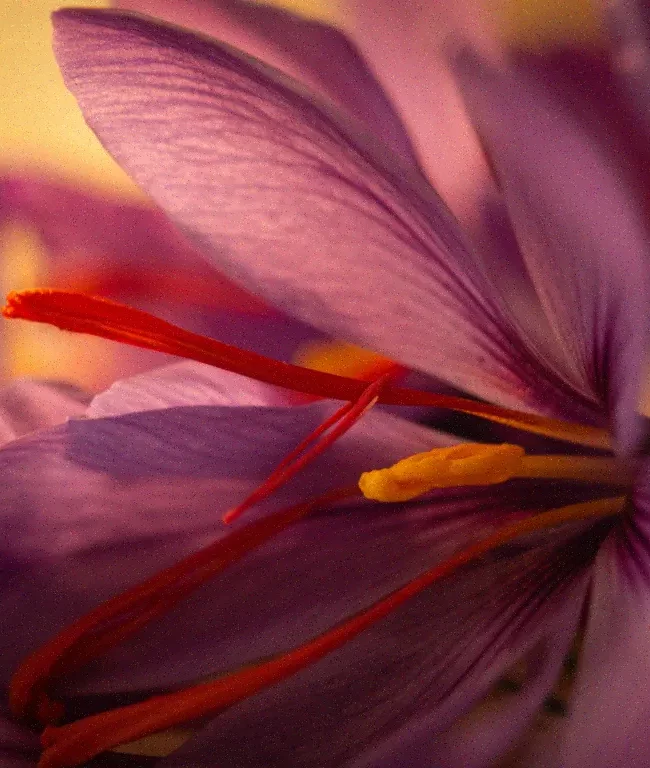
Safranal — the principal volatile of dried saffron — is a monoterpene aldehyde built on a gem-dimethyl cyclohexadiene ring. This same 2,6,6-trimethyl motif appears in isophorone, 4-ketoisophorone, and the ionone family. All these molecules activate overlapping olfactory receptor patterns that the brain reads as warm, dry, phenolic, leathery. The aldehyde function on safranal’s conjugated diene adds a sharp, angular, iodine-metallic dryness that specifically evokes tanned skin rather than sweet warmth. This is the chemical reason dried saffron smells like leather: its dominant volatile shares the fundamental skeleton of leather-associated terpenoid carbonyls.
The crucial distinction is between the kind of leather these materials produce. Birch tar’s phenols, cresols, and guaiacol create aggressive smoky-tarry-harsh impressions — polished military boots, smoked hides. Saffron’s terpenoid carbonyls create warm mineralic dryness embedded within a spicy-floral matrix — chamois, brushed nubuck, the inside of a kid glove. This is why saffron materials produce “soft” rather than “hard” leather: the leathery signal arrives wrapped in complexity, never isolated as raw aggression.
Natural saffron absolute delivers this most fully, combining safranal with isophorone, HTCC, crocin degradation products, and trace florals into a multidimensional metallic-honeyed-leathery texture. But at €5,000–15,000 per kilogram, unstable in alcohol, and heavily IFRA-restricted through its safranal content, the natural material is impractical for production work. This is precisely why Safraleine became the industry standard: it delivers the warm, velvety, leathery-saffron character without regulatory constraints. The molecule’s indenone ring system, though structurally distinct from safranal’s cyclohexadiene, produces the same receptor activation patterns through its arrangement of methyl-substituted unsaturated carbonyls on a rigid ring. The result is the same warmth, the same velvet, the same class — at a fraction of the regulatory burden.
Every saffron-derived material demands extreme restraint. Safranal blankets all other notes when overdosed, becoming acrid and medicinal. Safraleine “shoves aside” companion materials above 1%, flattening the composition into undifferentiated leather mud. Saffron absolute overwhelms through sheer complexity. These are steering molecules, not building blocks. They define direction at trace levels. A fraction of a percent is a statement; a full percent is a shout.
The supporting palette that frames the suede
Suede’s leathery core needs careful framing. The supporting materials do not add more leather — they add the context that makes leather read as suede: powder, skin warmth, textile softness, and transparent depth.
Cashmeran (IFF) occupies a unique textural position: drier than musk, softer than cedar, warmer than iris. Its name derives from the tactile impression of cashmere wool, and at low doses (below 1%), it produces a specific salty, slightly animalic “sun-kissed skin” effect. This bridges the cashmere-suede boundary perfectly. Use at 0.5–3% in the accord; above 2%, it can flatten delicate top notes.
Transparent musks provide the skin-like foundation that suede requires — but the choice of musk determines whether the accord reads as clean and modern or synthetic and soapy. Habanolide (dsm-Firmenich) is ideal as the dominant musk: metallic, clean, with subtle wood and animal facets in the drydown. Ethylene Brassylate adds textile-like fixation — “a clean, intimate murmur rather than a declared note” — with a faint ambrette quality that supports suede directly. Helvetolide contributes rare top-note musk radiance, a pear-skin transparency that helps the accord open rather than lurk. Avoid Galaxolide and nitro-musks: their soapy sweetness contradicts suede’s refined dryness.
Ambroxan adds clean lift and diffusion at low doses — the air that lets the accord breathe and project rather than sit flat on the skin. But this material demands a hard limit. Never exceed 1% of fragrance concentrate (equivalent to 0.20% in a finished 20% EDP). This is not an IFRA regulation — Ambroxan carries no IFRA restriction. This is a practitioner rule grounded in the material’s behavior: above 1%, Ambroxan shifts from transparent support to dominant amber identity, overwhelming the suede’s delicate texture. At 0.5% or below, it is invisible yet indispensable. At 4%, you no longer have a suede fragrance — you have an ambrox bomb with leather garnish.
Haitian vetiver grounds the accord with earthy depth while maintaining suede’s essential cleanliness. Haitian origin specifically — fresher and drier than Javanese vetiver, with a distinctive grapefruit citrus facet that prevents heaviness. Use at 1–3% for subtle anchoring.
Benzyl benzoate plays a dual role often underestimated by less experienced formulators. As a solvent, it dissolves Suederal LT, crystalline musks, and stubborn absolutes. As a fixative-blender, it smooths transitions and improves diffusion with only a faint balsamic whisper of its own. It is the hidden infrastructure of the accord — allocate 5–7% to serve both functions.
Labdanum and benzoin (Siam grade for its transparency) appear at trace levels — 1–2.5% and 0.5–1% respectively. Their role is thermal: they shift the accord from “cold” to “lived-in” without registering as identifiable sweetness or resin. Think of them as the difference between touching cool leather in a shop and leather warmed by someone’s body.
Proportional logic and the transparency paradox
The single most important principle in suede formulation is proportion. The leathery core — Suederal LT, Safraleine, Iso E Super, and their companions — should constitute roughly 45–55% of the accord’s weight. Powdery-textural materials (Isoraldeine 70, Cashmeran, Clearwood) run at 15–20%. The transparent base (musks, benzyl benzoate, resins, vetiver, Ambroxan) fills the remaining 30–35%.
This ratio ensures the accord reads as leather first, texture second, skin third. Reverse it — lead with musks and iris — and you get a powdery skin scent with a vague leathery whisper. That might suit some purposes, but it is not suede.
The transparency paradox — how can something feel both dense and transparent? — resolves through careful selection of the supporting materials. Density comes from high-molecular-weight fixatives that are olfactively quiet. Ethylene Brassylate, benzyl benzoate, and Iso E Super all contribute substantial physical body and longevity while smelling like almost nothing on their own. They are the hidden mass behind the accord. Transparency comes from keeping the identifiable materials light-handed. The suede molecule gives identity; the invisible infrastructure gives it substance. The accord feels heavy enough to register as leather, yet reads as effortless because the weight is carried by materials the nose cannot individually detect.
For use within a complete fragrance composition, dose the finished suede accord at 3–8% of total concentrate when suede is a supporting element, or 8–15% when suede is the fragrance’s central theme. Allow four to six weeks of maturation before evaluating the accord in a full formula — the components need time to fully integrate, particularly Suederal LT’s resinous complexity and the macrocyclic musks’ slow-blooming character.
A working suede accord formula
The following formula is IFRA-compliant for Category 4 fine fragrance (assuming 20% concentrate in finished EDP). All parts sum to exactly 100. Materials requiring dilution are noted. The accord expresses transparent, velvety suede — soft but not weak, powdery but not cosmetic, with tactile density and clean projection.
Suede core — 48 parts
Suederal LT (IFF)............................... 25.0
Primary suede character — dry, velvety, warm tobacco
Iso E Super..................................... 15.0
Transparent woody radiance, velvety diffusion
Norlimbanol 10% in DPG.......................... 3.0
Woody-leather projection across full pyramid
Safraleine...................................... 2.0
Warm saffron-leather velvet, rose-ketone lift
Cypriol (nagarmotha) oil........................ 2.0
Earthy cold-smoke grounding
Safranal 1% in DPG.............................. 1.0
Hay-leather minerality, angular warmth
                                                 ----
                                                 48.0
Powdery support — 20 parts
Isoraldeine 70.................................. 13.0
Powdery-suede bridge, woody iris body
Clearwood....................................... 4.0
Clean patchouli-woody depth, velvety warmth
Cashmeran....................................... 3.0
Cashmere textile softness, spicy skin warmth
                                                 ----
                                                 20.0
Transparent base — 32 parts
Ethylene Brassylate............................. 8.0
Textile-clean musk fixation, structural body
Benzyl benzoate................................. 7.0
Solvent for Suederal, diffusion enhancer
Habanolide...................................... 6.0
Clean metallic musk, modern skin quality
Helvetolide..................................... 3.5
Radiant top-note musk, pear-skin freshness
Vetiver oil (Haiti)............................. 3.0
Earthy-citrus grounding, natural depth
Labdanum absolute 50%........................... 2.0
Warm resinous glow, barely-there animalic heat
Saffron absolute 1% in DPG...................... 1.0
Honeyed-metallic leather complexity
Ambroxan........................................ 0.8
Clean lift, crystalline projection
Benzoin Siam resinoid........................... 0.7
Smooth balsamic warmth, almond-wax softness
                                                 ----
                                                 32.0
-----
TOTAL.......................................... 100.0Working notes: Pre-dissolve Suederal LT in the benzyl benzoate before combining with other materials — this prevents the solubility issues that plague rushed formulations. Pre-dissolve Cashmeran (solid at room temperature) in warm DPG or Iso E Super before incorporation. The Safranal and Saffron absolute dilutions at 1% are not optional: at full strength, both will obliterate the rest of the accord. Mature the completed accord for a minimum of four weeks at room temperature before evaluating or incorporating into a full composition. At 5–10% of a finished fragrance concentrate, this accord will deliver a recognizable suede presence; at 2–4%, it will function as a subliminal textural enhancer.
IFRA compliance at a glance
All materials in the formula above comply with IFRA 51st Amendment limits for Category 4 fine fragrance. The table below flags the materials with meaningful restrictions — limits stated as maximum percentage in fragrance concentrate (assuming 20% EDP dilution).
| Material | IFRA status | Max in concentrate | Formula level | Status |
|---|---|---|---|---|
| Safranal (actual content) | Restricted — sensitizer | 0.025% | 0.01% | ✅ Compliant |
| Norlimbanol (actual content) | Restricted | 6.5% | 0.3% | ✅ Compliant |
| Cashmeran | Restricted — sensitizer | 19% | 3.0% | ✅ Compliant |
| Iso E Super | Restricted (generous) | ~100% | 15% | ✅ Compliant |
| Isoraldeine 70 | Restricted (generous) | ~150% | 13% | ✅ Compliant |
| Benzyl benzoate | Restricted | 24% | 7.0% | ✅ Compliant |
| Ambroxan | No IFRA restriction | — | 0.8% | ✅ Under practitioner ceiling |
| Safraleine | No IFRA restriction | — | 2.0% | ✅ Potency is limiting factor |
| Suederal LT | No specific standard (blend) | Per IFF guidance | 25% | ✅ Within recommended range |
| Cypriol oil | No IFRA restriction | — | 2.0% | ✅ |
Isoraldeine 70 triggers EU allergen declaration (alpha-isomethyl ionone) at >0.001% in leave-on products. At 13% of concentrate in a 20% EDP, the finished product contains 2.6% — mandatory declaration on packaging. This is a labeling obligation, not a usage restriction.
Safranal is the regulatory bottleneck in any saffron-leather accord. Its 0.005% limit in finished product (0.025% in concentrate) effectively restricts it to trace-modifier status. This is exactly why Safraleine — carrying no IFRA restriction — has become the industry-standard replacement. The formula above uses both: Safraleine for structural leather warmth, safranal in trace for angular mineralic authenticity.
Conclusion
Suede is not diluted leather. It is a distinct olfactory idea — one built on the perception of texture rather than the memory of tanneries. The materials that create it share a common trait: they produce presence without volume, warmth without heat, density without weight. Mastering this paradox is what separates a suede accord from a leather accord with the edges sanded off.
The proportional insight bears repeating because it is the most common point of failure: the leather must dominate the powdery and musky elements, not the reverse. A suede accord weighted toward iris and musks becomes a skin scent. Only when Suederal, Safraleine, and their companions hold the center — framed but never obscured by powder, musk, and resin — does the composition achieve that unmistakable tactile quality: soft, radiating, velvety, unmistakably leather at any distance from the skin.
What makes suede so valuable to the modern perfumer is not just its wearability or regulatory friendliness. It is the way a well-built suede accord disappears into other compositions while elevating everything it touches. A vanilla oriental gains sophistication. A white floral gains depth. A musk gains substance. This is the real achievement of the suede aesthetic — not replacing classical leather, but offering something classical leather never could: the ability to enrich without dominating, to be felt without being heard.