Saffron in Perfumery: Safranal, Leathery Warmth, and the Chemistry of Spice
Few raw materials carry so much contradiction in a single drop. Saffron delivers a warmth that is simultaneously honeyed and metallic, leathery and floral, ancient and utterly modern — a duality that has made it one of the most compelling materials in the contemporary perfumer’s palette. Safranal, the molecule responsible for roughly 60–70% of saffron’s volatile character, does not even exist in the living flower. It emerges only through decay — the enzymatic breakdown of a bitter glycoside during drying — which means the scent we recognize as saffron is, in biochemical terms, the smell of controlled destruction. Understanding this material requires following that transformation from stigma to molecule to finished accord, and reckoning with the regulatory and economic realities that shape how saffron actually gets used at the bench.
150,000 flowers and a narrow autumn window
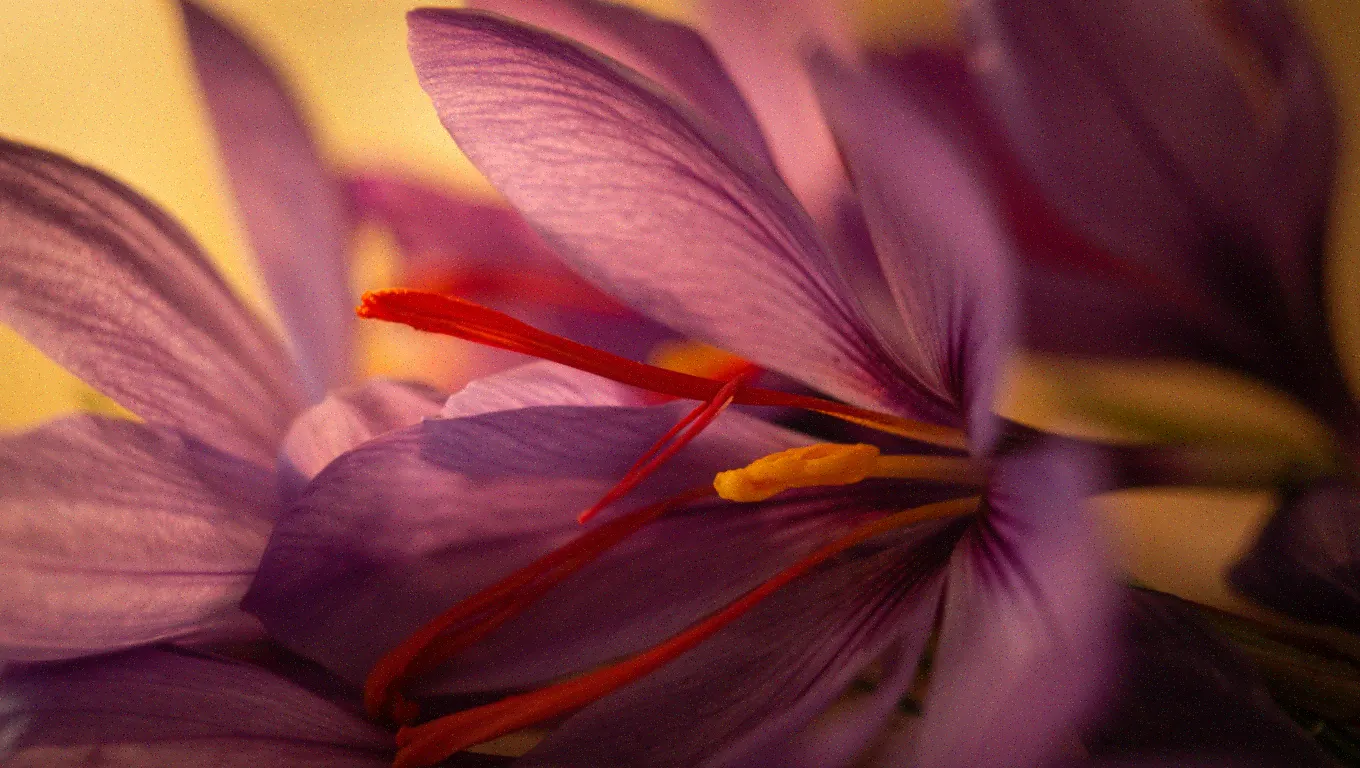
The saffron crocus (Crocus sativus) is a sterile triploid that reproduces only by corm division, making every harvest entirely dependent on human cultivation. Each flower produces exactly three stigmas — the slender crimson threads that constitute the spice. Harvesting must happen at dawn during a two-to-three-week autumn bloom, and roughly 150,000 flowers yield a single kilogram of dried saffron. Around 70% of production cost is labor. Iran produces approximately 90% of the global supply (300–400 tons annually), though Italian saffron from Navelli and Greek saffron from Kozani command premiums in perfumery for their cleaner olfactory profiles.
The economics become brutal at the extraction stage. Perfumer-chemist Arcadi Boix Camps, writing in Perfumer & Flavorist in 2008, reported that top-grade Spanish saffron yielded only 0.3% absolute by weight — meaning a kilogram of absolute requires roughly 300 kilograms of dried spice, itself the product of tens of millions of flowers. He calculated the production cost of his Spanish saffron absolute at approximately $900,000 per kilogram, a figure that renders natural saffron absolute economically impractical for commercial perfumery.
Three extraction forms matter to perfumers. Tincture — the oldest method — involves macerating dried stigmas in ethanol at concentrations of 1–20% by weight, producing intensely pigmented, deep orange-gold solutions with a characteristic hay-leather-medicinal character. Solvent-extracted absolute yields a dark red, pungent material that Boix Camps described as having a “liquorish, hay-like smell” with remarkable complexity — his GC-MS analysis identified over 170 distinct peaks. Supercritical CO₂ extraction, the modern standard, operates at low temperatures (~31°C, 74 bar) that preserve heat-labile compounds, producing extracts described as truer to the raw material’s natural character, with fuller retention of volatile and semi-volatile fractions. CO₂ extracts typically carry a different safranal-to-precursor ratio than solvent absolutes, which matters for IFRA compliance.
Variability runs deep. Drying method is the single greatest determinant of volatile profile: higher-temperature drying (80°C for 30 minutes) generates more safranal faster, while freeze-drying preserves precursors. Origin matters — Kashmiri saffron shows higher crocin content, while Italian saffron is prized for less color staining and a more refined scent. Even harvest timing within the short bloom window affects the balance of pigments and aroma precursors.
Safranal and the carotenoid cascade
Saffron’s molecular story begins with zeaxanthin, a yellow carotenoid pigment common in many plants. An enzyme called carotenoid cleavage dioxygenase slices zeaxanthin into three principal derivatives: crocin (the water-soluble red-gold pigment, non-volatile, no aroma contribution), picrocrocin (the bitter glycoside responsible for saffron’s taste), and safranal (the dominant aroma molecule). But here is the critical detail for perfumers: fresh saffron stigmas contain essentially zero safranal. The conversion pathway is sequential and drying-dependent.
Picrocrocin is first cleaved by β-glucosidase to yield HTCC (4-hydroxy-2,6,6-trimethyl-1-cyclohexene-1-carboxaldehyde) plus glucose. HTCC then undergoes dehydration during drying and storage to produce safranal. This means that a freshly harvested stigma smells green and herbaceous — almost anonymous. The warm, leathery, spice-shop character we identify as “saffron” develops only over days to weeks as picrocrocin reserves convert. Aged saffron has high safranal and low picrocrocin; fresh saffron shows the inverse.
Safranal (2,6,6-trimethyl-1,3-cyclohexadien-1-carboxaldehyde) constitutes 60–70% of saffron’s total volatile fraction by most GC analyses. It is the character-impact molecule, but attributing saffron’s full complexity to safranal alone is what Boix Camps called “olfactive ignorance” — akin to reducing lemon to citral or ambergris to Ambroxan. The supporting cast matters enormously.
Isophorone and β-isophorone are C9-norisoprenoid ketones derived from the same zeaxanthin degradation pathway. α-Isophorone smells camphoraceous and cooling in isolation; β-isophorone reads distinctly as “saffron, floral, hay” and serves as a freshness marker — high levels indicate recently harvested spice. 4-Ketoisophorone (also called oxophorone) contributes citrus-spicy facets and is another important aroma-active compound in saffron’s volatile fingerprint.
Perhaps the most intriguing molecule is what Boix Camps called safrandione (2,6,6-trimethylcyclohex-2-ene-1,4-dione), which he described as “the hidden soul of saffron” and “the saffron key.” He reported it is “much, much stronger than safranal” and that a convincing saffron effect requires both compounds in combination. He noted that safrandione is synthesized in quantity by a major fragrance house that “not coincidentally, wins the most important saffron briefings” — widely understood to refer to Givaudan.
A 1997 AEDA (Aroma Extract Dilution Analysis) study by Cadwallader, Baek, and Cai on Spanish saffron identified another compound — 2-hydroxy-4,4,6-trimethyl-2,5-cyclohexadien-1-one — and concluded it may play “an extremely important role in Spanish saffron aroma, even greater than that of safranal.” This compound delivers a dry, hay-like, saffron-specific character that complements safranal’s more aldehydic bite.
The question of which molecules drive which facets is central to formulation:
- The leathery-metallic-iodine character — saffron’s most distinctive and polarizing quality — derives primarily from safranal’s aldehydic nature, supported by HTCC and related hydroxylated cyclocitral derivatives. This phenolic edge is what makes saffron stand apart from other spice materials.
- The sweet-honeyed warmth emerges at dilution, as safranal’s sharp edges recede and β-isophorone’s floral-hay sweetness, β-ionone’s violet-woody character, and trace diacetyl’s buttery softness come forward. The honeyed quality is an ensemble effect, not attributable to a single molecule.
- The spicy-warm bite comes from safranal itself, 4-ketoisophorone’s citrus-spice contribution, and the overall matrix of carotenoid-derived monoterpene aldehydes and ketones that collectively produce the “warm, dry, oriental” impression.
One note on HDMF (Furaneol/2,5-dimethyl-4-hydroxy-3(2H)-furanone): despite occasional speculation, this sweet caramel compound has not been identified in standard GC-MS analyses of saffron and does not appear to be a natural constituent of the spice.
Reading saffron on the blotter and in the blend
Safranal is classified as high-strength with substantivity of approximately 64 hours at full concentration. Professional evaluations recommend smelling at 1% dilution or less — neat safranal overwhelms. At 1% in DPG, the character shifts toward fresh, herbal, phenolic, metallic, with tobacco-like undertones and a spicy finish. Multiple supplier descriptions converge on key descriptors: spicy, herbal, saffron, floral, tobacco, sweet, green, with a distinctive phenolic warmth that is immediately recognizable to anyone who has handled the spice.
Saffron’s behavior is markedly concentration-dependent, though differently from indole’s well-known fecal-to-floral shift. At high concentrations, saffron reads medicinal, iodine-like, acrid — the phenolic edge dominates and can be harsh, even off-putting. At moderate concentrations, the classic saffron signature emerges: leathery, warm, hay-like, spicy, with that characteristic metallic shimmer. At low concentrations, the material transforms into something sweeter, more honeyed and elegant — what one natural perfumer described as “a whispering, delightful, undistinguishable elegance.” This is the concentration-dependent behavior that matters most at the bench: saffron rewards restraint, and its beauty often lies in what it does just below the threshold of obvious identification.
On a smelling strip, saffron presents its full volatile cascade, including the initial metallic top that can read as challenging. On skin, body heat accelerates evolution — the metallic-spicy opening softens faster, and the leathery-honeyed drydown emerges sooner. The material spans heart to base, with initial impact strong enough to dominate an opening but persistence that carries into late drydown. Professional sources confirm that saffron aroma chemicals “don’t seem to fade” — in a composition, the saffron thread persists, which means it needs to be managed architecturally rather than treated as a fleeting top accent.
In blending, saffron sits naturally alongside materials that share its molecular heritage. Its volatile profile includes phenylethyl alcohol (the primary rose alcohol) and β-ionone (the signature violet compound), creating inherent chemical kinship with rose and iris materials. This molecular overlap explains why the saffron-rose pairing is one of the most natural in all of perfumery — not merely a cultural tradition from Middle Eastern attar-making, but a genuine molecular affinity. Saffron’s warm, dry leatheriness also provides natural contrast to creamy sandalwood, resinous labdanum, and the smoky animalic depth of oud, while its hay-coumarinic facets dovetail with tobacco and tonka.
From Safran Troublant to Crystal Saffron
Modern Western perfumery’s encounter with saffron as a featured note is relatively recent. Agent Provocateur (2000) is cited as the first Western fragrance to feature saffron prominently, but L’Artisan Parfumeur Safran Troublant (2002), composed by Olivia Giacobetti, is widely regarded as the composition that established saffron as a viable lead note in Western fragrance — its “medicinal and metallic but delicious saffron kick” demonstrated that the material could carry a composition rather than merely accent one.
The subsequent two decades saw saffron repositioned from a supporting player in Oriental bases to what the perfumery resource Galbanum.co describes as “a symbol of refined minimalism and intellectual warmth.” This shift accelerated around 2009 with the rise of Middle Eastern-influenced niche houses and oud-centric compositions, where the saffron-oud-rose triangle became a dominant commercial genre.
Montale has been among the most prolific users. Aoud Safran (2009) by Pierre Montale pairs saffron, Arabian rose, and agarwood in a deliberately simple three-note structure. Reviewers consistently note a “warm, buttery, red saffron” opening that demonstrates the material’s ability to read as simultaneously rich and radiant. Arabians Tonka (2019) pushes saffron harder still, with a “beast-mode” opening of saffron and sweet amber.
Maison Francis Kurkdjian’s Baccarat Rouge 540 (2015) uses saffron in a less expected context — not as a spice note in an oriental, but as a structural counterweight to jasmine. Saffron’s metallic-spicy facets prevent jasmine’s sweetness from becoming cloying, while jasmine softens saffron’s harder edges. Kurkdjian describes the composition not in conventional pyramid terms but as three “auras”: breeze (jasmine and saffron), heat (cedarwood), and mineral (ambergris). The Extrait version is notably more saffron-forward.
By Kilian’s Back to Black (2009), composed by Calice Becker, weaves saffron through a tobacco-honey-cherry composition where it functions as a spicy binding agent. Byredo Black Saffron (2012) by Jerome Epinette takes a darker, more suede-leathery approach, using saffron alongside leather accord and blonde woods — reviewers note the saffron here is more textural than aromatic, contributing a dry warmth rather than an identifiable spice note.
Perhaps the most ingredient-focused recent entry is Matière Première Crystal Saffron (2022), composed by Aurélien Guichard using natural Greek saffron oil from the Kozani region. Built around saffron, musk, Ambroxan, and incense, it aims for transparency rather than opacity — “the comfortable brightness of saffron” — and the 2024 Extrait version adds Somali myrrh oil with an even higher saffron dosage. Matière Première reports 85–92% natural ingredient content, making Crystal Saffron one of the few commercial fragrances to use natural saffron extract at meaningful levels.
Other notable saffron-forward compositions include Grossmith Saffron Rose (2012), which draws explicitly on Middle Eastern tradition with saffron, rose, oud, tobacco, and castoreum; Penhaligon’s Halfeti, which uses saffron as a spicy opening accent; and Ralph Lauren Saffron (2018) by Carlos Benaim, who enhanced saffron’s woody-hayish facets while masking its phenolic edge with suede and florals — a useful formulation strategy.
The synthetic toolkit and what it cannot quite capture
An estimated 99% of saffron notes in modern perfumery are synthetic. Given the economics and IFRA constraints on natural saffron, the working perfumer’s saffron palette is built primarily from three commercially available molecules, supplemented by captive materials from the major houses.
Safraleine (2,3,3-trimethylindan-1-one) is the workhorse. Developed by Givaudan and now widely available from suppliers including Pell Wall, Fraterworks, and Perfumer Supply House, it delivers a warm, leathery, phenolic character with tobacco facets and a faint honeyed sweetness. Boix Camps described it as “a great master chemical imparting subtleness, delicacy, refinement, intricacy, velvetiness and great class.” It pairs exceptionally with tobacco materials like Tabanone and with rose ketones. Professional usage runs 0.1–3% in a concentrate, with overdose up to 5% for leather-dominant effects (Memo Paris African Leather is cited as an example). Safraleine carries no IFRA restriction, making it the most versatile saffron material for the formulator. Its limitation: it leans more leather-tobacco than true saffron, and multiple professionals note it doesn’t capture saffron’s honeyed-metallic depth or the herbal-hay sweetness of the natural extract.
Ethyl Safranate (also marketed as Oriental Ester) delivers a complex rose-saffron-fruity character — spicy, peppery, apple-cider-like, with damascone overtones. Boix Camps called it “a product of extraordinary quality” with “a saffron subnote of remarkable strength.” It bridges the gap between saffron’s spice and rose’s fruitiness, and is unrestricted by IFRA. Average professional usage is around 0.4% in a concentrate, though published formulas show it as high as 8%. It is available from most specialty suppliers.
Synthetic safranal is commercially available — Ventós manufactures it, and it can be sourced through Perfumer Supply House and other channels. It is the molecule closest to natural saffron’s dominant volatile, but its severe IFRA restriction limits practical utility. Under IFRA Standard 082, safranal is restricted for dermal sensitization: the Category 4 (fine fragrance) limit is 0.012% in the finished consumer product, which translates to a maximum of 0.06% safranal in a concentrate applied at 20%. At these levels, safranal still contributes perceptible naturalism to a saffron accord, but it cannot carry the note alone. Working with safranal at 10% in DPG is standard practice — even diluted, it is potent enough to contribute meaningfully within IFRA limits.
Supporting molecules that expand the palette include β-cyclocitral (structurally one double bond removed from safranal, with a tropical-herbal character, unrestricted), 4-oxoisophorone (naturally present in saffron, musty-citrus, available from Hermitage Oils), and Firascone (a saffron-damascone hybrid useful for extending saffron character into the top notes). Safrandione, which Boix Camps identified as essential for accurate saffron reconstitution, appears to be captive or limited-distribution — unavailable to independent perfumers at retail.
What do synthetics lose? Boix Camps’ 2008 article — the most authoritative professional treatment of this question — argued that true saffron reconstitution requires 15 or more supporting molecules including safrandione, hydroxysafranal, hydroxy-β-cyclocitral, hydroxyisophorone, and numerous other carotenoid degradation products. His reconstitution formula (Saffron Concentrate 54246/D), built around safrandione, came “infinitely closer than simply using safranal” to the character of natural saffron absolute. The natural extract’s 170+ volatile components create a density and naturalism that no two- or three-molecule combination can fully replicate. What gets lost most noticeably is saffron’s “liquor-like herbal-hay” quality, the complex animalic undertone of real saffron threads, and the way natural saffron reads as simultaneously warm and cool — a paradox that emerges from the full molecular ensemble rather than any single component.
Regarding IFRA compliance for natural saffron materials: saffron absolute has no standalone IFRA Standard. Compliance is compositional — driven by the restricted constituents it contains, principally safranal (sensitizer, Standard 082) and isophorone (restricted for insufficient data, found at up to 0.2% in the absolute). The practical effect is that natural saffron absolute can be used in fine fragrance, but the safranal it contributes must be tracked against the Category 4 ceiling. CO₂ extracts and solvent-extracted absolutes may carry different safranal concentrations, so each batch must be assessed against its certificate of analysis.
Building a saffron-forward composition at the bench
Working with saffron requires respecting its potency. Natural saffron absolute should be diluted to 1–5% before incorporation; even then, it contributes at trace levels in the final concentrate — typically 0.1–0.5% for naturalistic accent, supported by unrestricted synthetics. Safraleine handles the heavy lifting for leathery body. Ethyl Safranate provides the rose-spice bridge. Safranal, at IFRA maximum, contributes the unmistakable naturalistic signature.
The perfumer Carlos Benaim’s approach to Ralph Lauren Saffron offers a useful formulation philosophy: enhance saffron’s woody-hayish facets, intensify its spicy qualities with contrasting spice materials (cool cardamom, warm black pepper, powdery cinnamon), and manage the phenolic-iodine edge with suede references and soft florals. A Basenotes forum consensus from experienced formulators suggests saffron works most effectively as a persistent heart-to-base thread supported by developed top notes — citrus and pink pepper provide necessary contrast and opening brightness that prevent saffron from reading as heavy or medicinal in the first minutes on skin.
The classic pairing logic for saffron, confirmed across decades of professional practice:
- Rose — molecular kinship through shared phenylethyl alcohol and ionone pathways; rose softens saffron’s medicinal edge while saffron gives rose structural warmth
- Oud and leather materials — saffron’s inherent phenolic character reinforces and deepens these accords naturally
- Tobacco and coumarin — shared hay-like, warm, coumarinic facets create a seamless textural blend
- Labdanum — dark resinous amber provides fixative depth and animalic warmth that grounds saffron
- Ionones — β-ionone and alpha-isomethyl ionone serve as the violet-powdery bridge between saffron’s carotenoid origins and the rest of a composition
The following showcase formula demonstrates saffron’s leathery-spicy warmth in a composition designed to foreground the material’s character. It is IFRA-compliant for fine fragrance at 20% concentrate in the finished product. Safranal content calculates to 0.01% in the finished product, under the Category 4 limit of 0.012%.
“Fil Rouge” — a saffron-leather showcase
Saffron core (12 parts)
Safraleine...................................... 4.0
Leathery-phenolic saffron backbone, tobacco facets
Ethyl Safranate................................. 5.0
Rose-saffron-fruity bridge, spicy-peppery
Safranal 10% in DPG............................. 0.5
Naturalistic metallic shimmer, IFRA-compliant trace
Alpha-Isomethyl Ionone.......................... 8.0
Violet-powdery cushion, carotenoid-derived cousin
Beta-Ionone 10% in DPG.......................... 2.5
Violet-woody sweetness, saffron's molecular kin
                                                 ----
                                                 20.0
Floral heart (9 parts)
Rose Absolute (Turkish)......................... 2.0
Molecular kinship via PEA and ionone pathways
Phenylethyl Alcohol............................. 5.0
Rose diffusion, softens phenolic edge
Geranium Bourbon EO............................. 2.0
Rosy-green texture, complexity
                                                 ----
                                                 9.0
Leather and tobacco (8.5 parts)
Suederal........................................ 2.0
Dry phenolic smokiness, suede-leather
Isobutyl Quinoline 10% in DPG................... 1.5
Green-leather bite, diluted for control
Tobacco Absolute 10% in DPG..................... 2.0
Hay-tobacco warmth, coumarinic depth
Coumarin........................................ 3.0
Hay-tonka warmth, reinforces tobacco facets
                                                 ----
                                                 8.5
Spice (3.5 parts)
Cardamom EO..................................... 2.0
Cool spice contrast to saffron's warmth
Black Pepper CO2................................ 1.5
Dry peppery bite, reinforces spice character
                                                 ----
                                                 3.5
Amber-resinous base (14 parts)
Labdanum Absolute............................... 6.0
Dark animalic resin, saffron's natural base partner
Benzoin Resinoid (Siam)......................... 4.0
Sweet balsamic depth, vanillic warmth
Ambroxan 10% in DPG............................. 4.0
Crystalline radiance, extends projection
                                                 ----
                                                 14.0
Woody foundation (26 parts)
Iso E Super..................................... 15.0
Velvety diffusion, structural backbone
Javanol......................................... 5.0
Creamy sandalwood warmth, traditional carrier
Cedarwood Virginia EO........................... 6.0
Dry pencil-shaving, supports leather facet
                                                 ----
                                                 26.0
Musk and fixative (9 parts)
Habanolide...................................... 5.0
Warm macrocyclic musk, skin-close
Ethylene Brassylate............................. 4.0
Creamy macrocyclic musk, fixative depth
                                                 ----
                                                 9.0
Bright top (10 parts)
Bergamot EO (FCF)............................... 5.0
Citrus brightness, prevents heavy opening
Pink Pepper CO2................................. 2.0
Spicy-fresh contrast, top brightness
Frankincense EO (Boswellia carterii)............ 3.0
Resinous lift, incense-sacral quality
                                                 ----
                                                 10.0
-----
TOTAL........................................... 100.0The formula is organized by function rather than conventional pyramid. The saffron core (20 parts) carries the composition’s identity: Safraleine provides the leathery-phenolic backbone, Ethyl Safranate bridges toward rose and spice, and the safranal at IFRA-compliant trace level adds the naturalistic metallic shimmer that distinguishes real saffron character from generic spice. The ionones serve double duty — they are saffron’s biochemical cousins (both carotenoid-derived) and they provide the powdery-violet cushion that makes the saffron accord wearable rather than harsh.
The leather-tobacco group (8.5 parts) amplifies facets already inherent in saffron: Suederal’s dry phenolic smokiness, Isobutyl Quinoline’s green-leather bite (diluted to manage its intensity), and coumarin’s hay-tonka warmth all reinforce rather than compete with the saffron core. The floral heart (9 parts) softens the composition’s harder edges through rose’s molecular kinship with saffron, while geranium’s rosy-green character adds textural complexity.
The woody foundation (26 parts) is deliberately transparent. Iso E Super at 15 parts provides velvety diffusion and structural backbone without imposing a recognizable woody identity. Javanol gives creamy sandalwood warmth — the traditional carrier for saffron in Indian attar-making — while Virginia cedarwood’s dry, pencil-shaving quality supports the leather facet. The amber-resinous base (14 parts) anchors the drydown: labdanum’s dark, animalic resin is saffron’s most natural partner in base notes, benzoin adds sweet balsamic depth, and Ambroxan 10% in DPG contributes crystalline radiance that extends projection while keeping the actual Ambroxan concentration within safe limits.
Pink pepper and bergamot in the top provide the opening brightness that prevents the saffron-leather core from reading as heavy in the first seconds on skin. Frankincense adds resinous lift and a slight incense-like sacral quality that complements saffron’s associations with ritual and luxury.
Conclusion
Saffron occupies a singular position in the perfumer’s palette — a material whose character is born entirely from degradation, whose most important molecule did not exist in the living plant, and whose full complexity resists reduction to any single synthetic surrogate. The practical reality is that almost all commercial saffron is synthetic, built on the Safraleine–Ethyl Safranate–safranal triad within IFRA constraints. But the material rewards deeper understanding. Knowing that saffron’s leathery metallic edge comes from safranal’s aldehydic bite while its honeyed sweetness emerges from the ensemble of isophorones and ionones at dilution — knowing that concentration shifts its entire personality from harsh to elegant — allows the perfumer to use it with precision rather than instinct alone. Safrandione, the “hidden soul” that Boix Camps identified, remains largely captive, which means the full natural saffron effect is still beyond straightforward synthetic reconstruction. For now, the material’s tension between accessibility and irreducibility is part of what makes it worth working with: saffron gives the perfumer enough synthetic tools to approximate its character, but holds back just enough complexity to ensure the natural extract still has something to teach.