Cigar Accord Construction: Tobacco Sweetness, Aged Leaves, and Smoky Resin Chemistry
A convincing cigar accord is one of perfumery’s most demanding compositional challenges — not because the individual materials are exotic, but because the reference itself is irreducibly multisensory. The smell of a fine cigar encodes fermentation chemistry, decades of cedar-lined aging, the alkaline haze of slow combustion, and an entire mythology of leather-and-whisky contemplation. To build a cigar accord that reads as genuine rather than decorative, the perfumer must understand what generates the smell at a molecular level, what distinguishes it from cheaper tobaccos, and how ritual context invisibly shapes what we perceive as “cigar.” This article dissects each layer — from leaf to lounge to laboratory — and offers a working formula designed for fine fragrance application.
Why cigar smoke smells nothing like a cigarette
The distinction between cigar and cigarette smoke is not a matter of degree. It is phenomenologically categorical, rooted in fundamentally different chemistry. Cigar smoke is alkaline, typically pH ~8.5, while cigarette smoke is acidic at roughly pH 5.3. This single variable reshapes everything: the weight, the linger, the way volatile compounds behave in air and on skin.
Premium cigars contain only whole-leaf tobacco — no reconstituted sheet, no burn accelerants, no paper, no ammonia-boosting additives. The aromatic payload is entirely tobacco-derived, a pure expression of terroir and fermentation. Cigarette smoke, by contrast, carries the combustion products of paper, chemical additives, and processed stems through deep lung inhalation, producing a flat, acrid, monochromatic burn. Cigar smoke is held in the mouth and expelled, engaging retronasal olfaction — the same neural pathway that creates flavor in wine and food tasting. The slower puffing cadence produces incomplete combustion, generating a heavier load of aldehydes, ketones, pyrazines, phenolics, and terpene derivatives. Where cigarette smoke is sharp and linear, cigar smoke unfolds.
This is the perceptual core that a cigar accord must capture: not just “smoke” but stratified, alkaline, room-filling richness — the olfactory equivalent of bass frequencies that you feel in the chest before you consciously hear them.
The phenomenology of the leaf itself
Understanding cigar aroma means understanding that every stage of production — from soil to fermentation pile to humidor — deposits a distinct chemical signature onto the leaf.
Terroir writes the first draft. Cuban tobacco from the Vuelta Abajo’s mineral-rich red clay yields an earthy, tangy complexity that aficionados call “the twang” — a sharp, almost saline undertone layered with leather, cocoa, and cedar. Nicaraguan leaf, grown in volcanic soil around Estelí and Jalapa, runs bolder: dense pepper, dark chocolate, espresso, a pulpy texture and aggressive spice born from nitrogen-rich earth. Dominican tobacco from the limestone Cibao Valley tends toward refinement — smoother, nuttier, creamier, with a restrained elegance. Honduran leaf from the Danlí and Jamastran valleys carries a flinty earthiness and savory depth, sometimes described as the closest non-Cuban approximation of Havana character.
The wrapper dominates the olfactory impression. Though it constitutes the least tobacco by weight, the wrapper contributes an outsized proportion of perceived aroma — often cited at 60–80% of total flavor, particularly in thinner ring gauges where the wrapper-to-filler ratio is high. Connecticut Shade-grown wrappers deliver mild, creamy, hay-and-vanilla sweetness. Connecticut Broadleaf, grown in direct sun, develops rich dark-chocolate and raisin sweetness. Maduro wrappers — not a seed variety but a process of extended fermentation at elevated temperatures — undergo caramelization of surface oils, yielding espresso, molasses, and a paradoxical mellowness despite their near-black appearance. Habano-seed wrappers, often Nicaraguan- or Ecuadorian-grown, bring pronounced pepper and earthy spice. Cameroon wrappers, grown from Sumatran seed in Central Africa, offer an unusual baking-spice sweetness with cinnamon and nutmeg overtones, their characteristic “toothy” surface — oil-filled bumps — releasing extra aromatics.
Fermentation is where raw leaf becomes cigar. After air-curing converts chlorophyll to amber and starches to sugars, tobacco is stacked in massive pilones — piles of 1,000+ kilograms — and left to undergo microbially driven fermentation at carefully controlled temperatures between 108–140°F. The chemistry is extraordinary in its diversity. Maillard reactions between reducing sugars and amino acids produce pyrazines (roasted nut, cocoa, toast), furans (caramel, bread), and pyrroles (baked character). Carotenoid pigments degrade into ionones, damascones, and megastigmatrienones — the elegant fruity-floral compounds that distinguish premium tobacco from commodity leaf. Polyphenols oxidize and polymerize, shifting flavor from green and astringent to mellow and earthy. Ammonia, generated from protein breakdown, is gradually driven off; residual ammonia in poorly fermented cigars produces the acrid sourness that experienced smokers immediately detect.
The difference between a cold draw and a lit cigar is the difference between reading a score and hearing the orchestra. The pre-light aroma — dried fruit, hay, cocoa, barnyard, spice, and the cedar imprint of the humidor — reveals the raw character of aged fermented tobacco. Combustion then introduces pyrolysis products, phenolics, and Maillard-derived volatiles that overlay, transform, and amplify the baseline into something far more complex. Through three distinct phases — the mild opening third, the complex middle, and the intense, filler-dominated finale — the cigar narrates itself temporally, a quality that maps directly onto perfumery’s top-heart-base structure.
The lounge is part of the accord
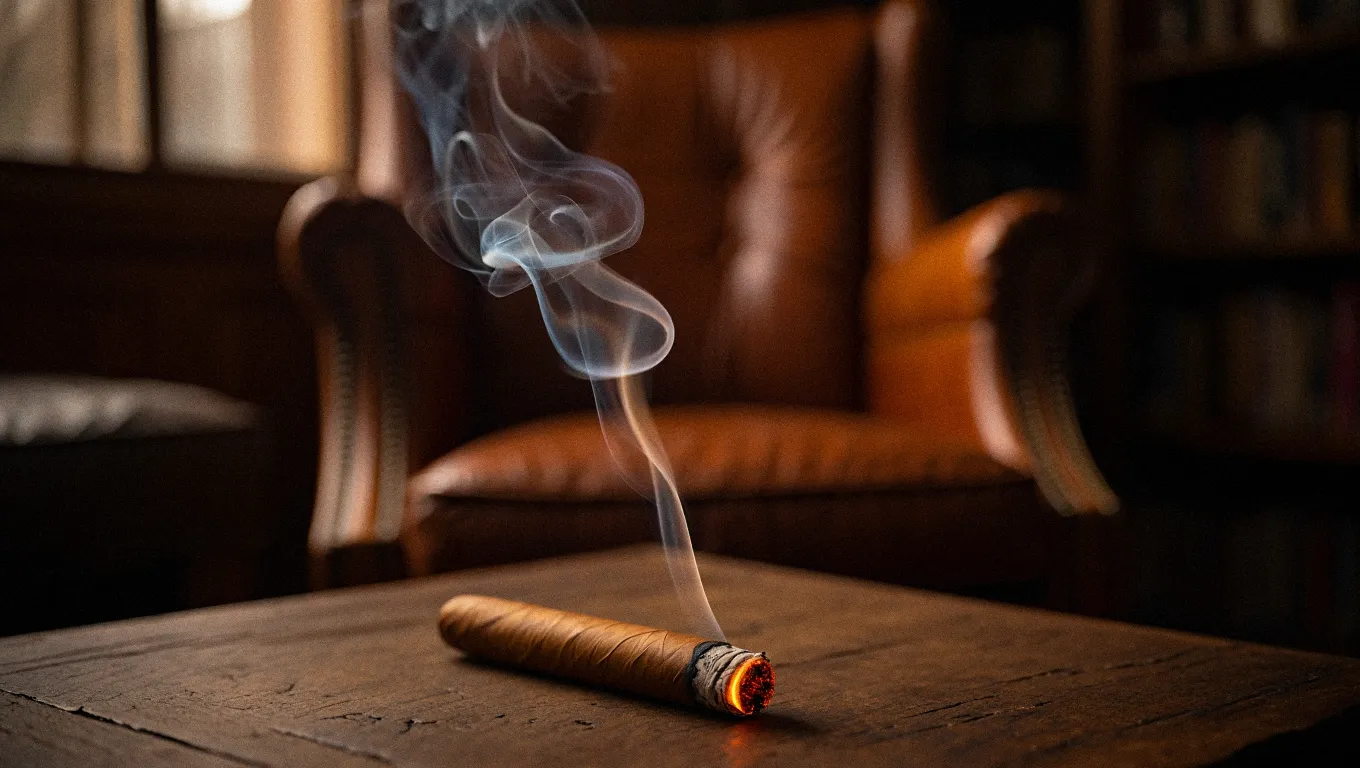
No serious discussion of the cigar accord can ignore the environment in which cigars are actually smoked, because olfactory perception is never processed in isolation. Research in multisensory integration consistently shows that congruent environmental cues amplify perceived olfactory richness — visual luxury primes the brain to read an aroma as more complex, more refined, more valuable. The cigar lounge is a masterclass in this principle: leather armchairs, mahogany paneling, amber light, the accumulated patina of decades of smoke absorbed into every porous surface. Each element reinforces a single sensory narrative.
The humidor itself constitutes an olfactory prelude. Opening a well-maintained Spanish cedar box releases a rush of humid, resinous, tobacco-scented air — a moment of anticipation that neurologically primes the olfactory system. The pairing tradition extends this cross-modal staging further. Cognac, single malt Scotch, aged rum — these are not merely accompaniments. Through retronasal olfaction, where volatiles from the mouth travel through the nasopharynx to the olfactory epithelium, whisky and cigar smoke create what researchers call a “flavor object” — a combined impression greater than the sum of its parts. Approximately 80% of flavor perception derives from retronasal olfaction, which is why the spirit pairing feels inseparable from the cigar experience itself.
The ritual operates on anticipation. Selecting, inspecting, cutting, toasting the foot with a cedar spill, the first draw — each step builds sensory engagement before the main event. A cigar demands 30 minutes to two hours, enforcing the slowness that luxury codes as scarcity of time. The smoke evolves; the drink evolves; the room itself participates, its olfactory sediment — years of absorbed smoke layered into wood and leather — forming a kind of aromatic terroir unique to each space.
For the perfumer, the implication is direct: a cigar accord that captures only the tobacco note and ignores the environmental context will always read as incomplete. The most successful cigar fragrances — from Serge Lutens’ Chergui to Tom Ford’s Tobacco Vanille — embed the room in the formula. Leather, aged wood, amber warmth, and boozy dried-fruit notes are not accessories. They are structurally necessary because they replicate the cross-modal amplification that makes a cigar smell like a cigar.
The molecular anatomy of cigar character
Building a cigar accord requires understanding six distinct olfactory layers, each with its own chemistry. The artistry lies in their proportion and integration.
The tobacco leaf itself — fermented, cured, aged — provides the accord’s identity. The single most characteristic molecule is megastigmatrienone, sold commercially as Tabanone by Symrise. Arcadi Boix Camps called it “a product of supreme importance” with “indescribable tobacco scents — fruity, radiant, powerful and brilliant.” It is a carotenoid degradation product, formed naturally during leaf senescence and fermentation, and it is what makes tobacco smell specifically like tobacco rather than like any other dried plant material. β-Damascenone (detection threshold 0.0007 ppb — among the most potent odorants known) contributes sweet, plum-raisin, tea-like depth, the dried-fruit facet that anchors aged cigar character. Solanone, another cembranoid degradation product, contributes a floral-sweet tobacco note whose concentration increases dramatically during wrapper fermentation. β-Ionone provides the powdery, violet-woody quality that links tobacco to iris and orris. Coumarin delivers the hay-sweet warmth that is perhaps the most immediately recognizable element of the tobacco accord family.
Tobacco absolute, extracted from cured Nicotiana tabacum leaves, is the perfumer’s most direct access to authentic leaf character. Diluted from its near-repulsive concentrated state to working levels in DPG, it reveals leathery, woody, ambery notes reminiscent of dried leaves and warm smoke. Modern commercial versions are denicotinized below 800 ppm. Virginia-type absolute reads bright and sweet; Burley is darker, richer, more fruity; Oriental is dry, hay-like, mature. Typical usage is 0.5–3% in the final concentrate, always from a 10% predilution.
The smoke layer derives from phenolic compounds — the same family responsible for the smell of wood fire, smoked meat, and leather tanning. Guaiacol is the foundational smoke molecule: phenolic, dry, persistent beyond 600 hours on blotter at 1% dilution. 4-Methylguaiacol (creosol) adds a toasted, vanilla-ash character. Syringol, with its additional methoxy group, delivers sweeter, less medicinal smokiness than guaiacol and contributes more to smoky scent than any other single phenol. Para-cresol, at microlevels, introduces the animalic-leathery-smoky quality that bridges the smoke and leather categories. The distinction between “cold smoke” and “warm smoke” is critical for cigar work. Cold smoke — the smell of smoked leather, of spent ash, of a room the morning after — is built from birch tar (rectified), cade oil, and cresolic materials, emphasizing the dark, ashen, phenolic dimension. Warm smoke — the smell of the burning cigar itself — requires layering guaiacol derivatives with sweet-balsamic materials (vanillin, benzoin, labdanum) and isoeugenol’s smoky-woody-spicy bridge note. A credible cigar accord needs both: warm smoke in the heart, cold smoke in the dry-down.
The cedar-humidor layer presents a taxonomic subtlety that matters enormously. The “cedar” of cigar humidors is not cedar at all — Cedrela odorata, Spanish cedar, is a mahogany-family hardwood with a warm, resinous, slightly sweet character distinct from the sharp pencil-shavings of true Juniperus. In practice, the humidor note is best approximated by blending Virginia cedarwood oil (for its cedrol-driven dry-woody character) with Atlas cedarwood (for balsamic depth), supported by Cedryl Acetate and Vertofix Coeur as fixatives. The goal is a woody warmth that evokes enclosed resinous wood aged with tobacco rather than a freshly cut lumber yard.
The leather dimension replicates the slightly animalic quality of fermented wrapper leaves, whose phenolic compounds overlap significantly with actual leather-tanning chemistry. Isobutyl quinoline remains the definitive leather molecule — intense, earthy, rooty, tenacious beyond 160 hours. Commercially supplied at 10% in benzyl benzoate, it functions at trace levels; exceeding 0.5% overwhelms the composition. Pyralone (Givaudan) offers a finer, more tobacco-like leather alternative. Castoreum, now almost entirely synthetic in practice, adds warm animalic roundness; reconstructions typically combine birch tar, para-cresol, bornyl acetate, and anisyl acetate.
The sweet-balsamic anchor prevents the accord from becoming austere or abrasive. Vanillin is indispensable — it softens the phenolics and adds the gourmand warmth associated with pipe and cigar tobacco. Labdanum absolute provides the amber-resinous foundation and contributes its own subtle animalic edge, sometimes called “vegetable ambergris.” Benzoin adds soft, vanilla-adjacent balsamic character. Tolu balsam introduces a chocolate-liquorous depth. Benzyl benzoate, though nearly odorless, functions as the accord’s structural fixative and carrier for potent materials like IBQ and para-cresol.
The spice facet reflects compounds that appear naturally in tobacco fermentation. Eugenol (warm, clove) is present in fermented tobacco itself and functions as both a spice note and a phenolic bridge to the smoke layer. Black pepper oil provides sharp, woody-spicy lift through β-caryophyllene and trace rotundone. Nutmeg oil contributes warm aromatic complexity through myristicin and elemicin alongside its own eugenol content.
A working cigar accord formula
The following formula is designed as a professional cigar accord concentrate intended for use at 15–20% of the total fragrance compound in fine fragrance applications (EdP at 15–20% concentration). All parts are by weight, totaling 1000. Materials listed with dilution percentages should be used as indicated — these predilutions are standard industry practice for potent aromachemicals. Maturation time: minimum two weeks, optimally four, in sealed dark glass at 15–20°C.
I. Tobacco heart (275 parts)
Dihydro-β-Ionone ................... 120
Dry violet-woody backbone; carotenoid-derived, naturally present in tobacco
Coumarin ............................ 80
Hay-sweet warmth; the most recognizable tobacco accord element. IFRA 51: max 1.5% in finished product
Tobacco Absolute (10% in DPG) ....... 40
Authentic fermented leaf character — leathery, sweet, herbaceous
Hay Absolute (10% in TEC) ........... 15
Coumarinic dried-herb naturalness; reinforces the unlit-tobacco facet
Tabanone (10% in DPG) ............... 15
Megastigmatrienone — the signature tobacco molecule. Fruity-warm, indispensable
β-Damascenone (1% dilution) .......... 5
Dried fruit, plum-raisin depth. Emerges fully only after maceration
────────────────────────────────────────
SUBTOTAL ........................... 275
II. Smoke layer (60 parts)
Birch Tar Rectified (1% in DPG) ..... 20
Cold-smoke leather, ashen quality. IFRA: rectified only; PAH markers <1 ppb in finished product
Guaiacol (1% in DPG) ................ 15
Dry, clean phenolic smoke — the foundational smoke molecule
Cade Oil Rectified (10% in DPG) ..... 10
Warm, resinous, juniper-fire smoke. IFRA: rectified only; combined PAH limits apply
Isoeugenol .......................... 10
Smoky-woody-spicy bridge between smoke and spice layers. IFRA 51: max 0.11% in finished product — calculate dilution carefully
4-Methylguaiacol (1% in DPG) ......... 5
Toasted, vanilla-ash, brown-sugar smoke character
────────────────────────────────────────
SUBTOTAL ............................ 60
III. Cedar-humidor structure (230 parts)
Virginia Cedarwood Oil ............. 120
Dry pencil-shavings cedar; cedrol provides the humidor backbone
Vertofix Coeur ...................... 50
Substantive smooth woody-amber fixative; extends the cedar impression
Atlas Cedarwood Oil ................. 35
Balsamic woody depth; rounder and warmer than Virginia
Cedryl Acetate ...................... 25
Smooth, persistent cedar fixative; less sharp than the raw oil
────────────────────────────────────────
SUBTOTAL ........................... 230
IV. Leather-animalic character (40 parts)
Isobutyl Quinoline (10% in BB) ...... 20
Classic dry leather — intense, earthy, mossy. Sold prediluted; trace impact
Castoreum Reconstitution ............ 12
Warm animalic roundness; synthetic base of birch tar, cresol, bornyl acetate
Para-Cresol (1% in DPG) .............. 8
Animalic-smoky quality at subthreshold; bridges leather and smoke. IFRA 51: max 0.05% in finished product
────────────────────────────────────────
SUBTOTAL ............................ 40
V. Sweet-balsamic anchor (290 parts)
Benzyl Benzoate .................... 120
Near-odorless fixative and carrier; structural solvent for the accord. IFRA 51: max 4.8% in finished product
Labdanum Absolute ................... 60
Amber-resinous foundation; subtle animalic warmth; "vegetable ambergris"
Vanillin ............................ 50
Sweet vanilla warmth; softens phenolics; the gourmand dimension of cigar tobacco
Benzoin Siam Resinoid ............... 40
Soft balsamic-vanilla warmth; rounds the base
Tolu Balsam ......................... 20
Chocolate-balsamic-liquorous depth; enhances the dried-fruit impression
────────────────────────────────────────
SUBTOTAL ........................... 290
VI. Spice facets (50 parts)
Eugenol ............................. 25
Warm clove spice; naturally present in fermented tobacco; phenolic bridge. IFRA 51: max 2.5% in finished product
Black Pepper Oil (CO₂) .............. 15
Sharp pepper-woody lift; β-caryophyllene and trace rotundone
Nutmeg Oil .......................... 10
Warm aromatic complexity; myristicin, elemicin, traces of eugenol
────────────────────────────────────────
SUBTOTAL ............................ 50
VII. Modifiers and lift (55 parts)
Clary Sage Oil ...................... 30
Herbal-aromatic with inherent tobacco-like undertone; natural linalyl acetate
Immortelle Absolute (10% in DPG) .... 15
Warm hay-caramel-tobacco; honey-maple facet; enriches the coumarinic layer
Ethyl Maltol (10% in DPG) ........... 10
Burnt-sugar cotton-candy sweetness; enhances perceived warmth at trace levels
────────────────────────────────────────
SUBTOTAL ............................ 55
════════════════════════════════════════
TOTAL ............................. 1000IFRA compliance notes for finished product calculation: At a typical deployment of 20% accord in a fragrance concentrate used at 17.5% (EdP midpoint), the finished-product percentages for restricted materials fall well within IFRA 51st Amendment limits. Coumarin in finished product: ~0.28% (limit: 1.5%). Isoeugenol: ~0.035% (limit: 0.11%). Para-cresol actual: ~0.00028% (limit: 0.05%). Eugenol: ~0.088% (limit: 2.5%). All birch tar and cade oil materials are used in rectified form only, with combined PAH markers requiring verification below 1 ppb in the consumer product. Peru balsam crude is deliberately excluded (prohibited since 1982); Tolu balsam remains permissible.
Working notes: The accord leans toward a warm, aged, slightly sweet cigar profile reminiscent of a Maduro wrapper with Dominican filler — chocolatey, leathery, and cedar-rich rather than aggressively peppery. For a more Nicaraguan-forward, spice-driven interpretation, increase eugenol to 35 parts, add 5 parts cinnamaldehyde, and reduce vanillin to 35 parts. For a drier, more austere unlit-cigar humidor effect, reduce the sweet-balsamic section by 15% and increase Virginia cedarwood to 150 parts. The formula rewards patience: β-damascenone and tobacco absolute reveal their full character only after maceration, and the accord will shift noticeably between week one and week four.
What this accord is actually trying to do
The formula above encodes a specific olfactory argument: that the cigar experience is fundamentally about the tension between sweetness and smoke, between organic decay (fermentation) and mineral precision (cedar, ash). The tobacco heart — dominated by ionones and coumarin — establishes the dried-leaf identity. The smoke layer, built from phenolics at carefully controlled microdoses, adds the combustion dimension without overwhelming the composition’s wearability. The cedar-humidor section grounds everything in the specific woody context that distinguishes cigar from generic tobacco. The leather-animalic trace introduces the slightly uncomfortable, slightly animal quality of genuinely fermented leaf — the quality that separates a perfumer’s cigar accord from a candle-maker’s.
The sweet-balsamic anchor is the largest section by weight for a reason. It is not there to make the accord “gourmand.” It is there because labdanum, benzoin, vanillin, and tolu balsam perform the same function that years of aging perform on an actual cigar: they integrate sharp edges, provide the warmth that makes complexity pleasurable rather than aggressive, and create the olfactory illusion of time. A cigar that has not been aged smells raw and ammoniac. A cigar accord without sufficient balsamic foundation smells like a chemistry demonstration.
The spice and modifier sections function as the accord’s terroir markers — the elements a perfumer adjusts to place their cigar in a specific cultural geography. More clove and pepper suggest Nicaraguan boldness. More hay and immortelle suggest the dry-leaf delicacy of a Connecticut Shade. More vanilla and tolu suggest the dark sweetness of Maduro. This is where individual authorship enters the formula.
Conclusion
A cigar accord that genuinely works in fine fragrance requires the perfumer to think beyond the note list and into the phenomenology of the reference itself. The cigar is alkaline where the cigarette is acidic, slow where smoking is fast, contextual where most smells are isolated. Its aroma is the product of terroir, microbial fermentation, Maillard chemistry, carotenoid degradation, and years of cedar-scented aging — and then, only then, combustion. The ritual environment — leather, wood, spirits, accumulated decades of smoke in the walls — is not context for the smell; it is part of the smell, amplified by the same cross-modal mechanisms that make food taste better in a beautiful room.
The molecular toolkit is well established: megastigmatrienone for signature tobacco identity, damascenone for dried-fruit depth, guaiacol and syringol for smoke, cedarwood oils for the humidor, IBQ for leather, and a substantial balsamic foundation to simulate the integrating effect of time. What distinguishes a skilled cigar accord from a clumsy one is not the ingredient list but the proportional thinking — knowing that para-cresol at 0.008% actual concentration provides subliminal animalic truth while at 0.08% it provides a headache, knowing that the humidor is 23% of the formula by weight because the cedar box is 90% of the olfactory memory, knowing that damascenone at five parts per thousand will be invisible on day one and luminous on day thirty. The cigar accord, like the cigar itself, is an argument for patience — for letting fermentation do its quiet, transformative work.