

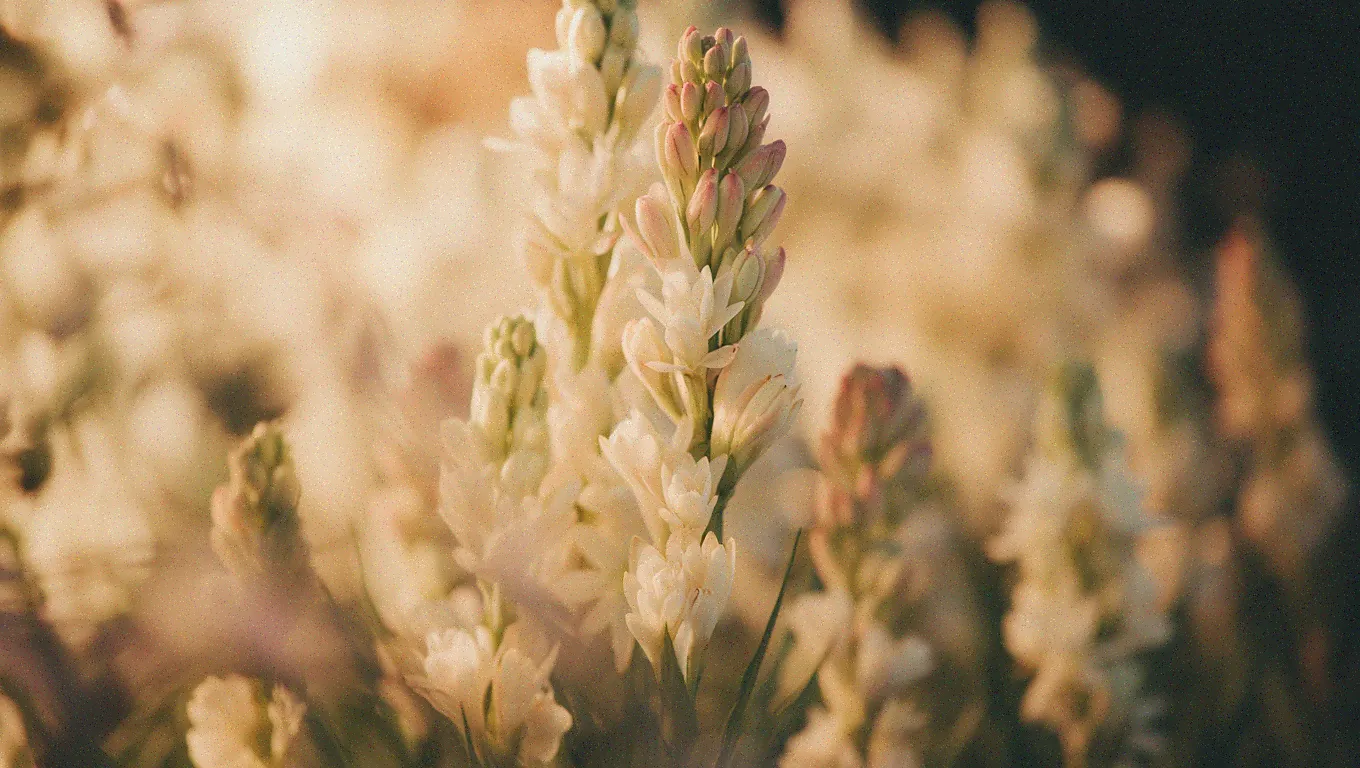
The Art of Narcotic Florals: Tuberose Absolute, Modern Synthetics, and Accord Construction
Tuberose (Polianthes tuberosa) stands among perfumery’s most complex naturals, commanding $300–450 per ounce for its absolute while serving as the narcotic heart of legendary fragrances from Fracas to Carnal Flower. The flower’s olfactory magic stems from an extraordinary chemical profile—over 40% methyl isoeugenol combined with 13% jasmin lactone—that creates what Roja Dove famously called “the harlot of perfumery.” For working perfumers, mastering tuberose reconstruction requires understanding both the natural’s composition and the modern synthetics that capture its multifaceted character: green-camphoraceous top notes, an intoxicating narcotic heart, and a creamy lactonic base that lingers for days.
The chemistry behind tuberose’s seductive complexity
Natural tuberose absolute presents one of perfumery’s most layered olfactory profiles. The top notes open green and surprisingly medicinal—methyl salicylate at 4.6% delivers a distinctive wintergreen freshness (exaggerated famously in Serge Lutens’ Tubéreuse Criminelle), while 1,8-cineole contributes camphoraceous lift. The spicy facet comes from a phenylpropanoid complex: methyl isoeugenol dominates at 40.8%, supported by isoeugenol (1.8%) and eugenol (0.5%). This phenylpropanoid backbone is crucial—perfumers attempting reconstruction without it will miss tuberose’s characteristic warmth.
The heart reveals why perfumers describe tuberose as creating “an olfactive illusion of multiple flowers.” Methyl anthranilate (4.4%) provides grape-like sweetness and orange blossom character; it forms Schiff bases with aldehydes over time, creating the complex Aurantiol-type accords that deepen during maceration. The indole content—naturally present at 0.02–2%—generates tuberose’s notorious carnal, narcotic quality without crossing into the fecal territory that higher concentrations produce.
The base character emerges from tuberose’s exceptional lactone content. Jasmin lactone at 13.3% creates the creamy, coconut-milk sweetness that separates tuberose from other white florals, while delta-decalactone (2%) reinforces buttery richness. Benzyl benzoate (10.6%) and benzyl salicylate (2.2%) provide balsamic fixation and the “solar” quality that makes tuberose compositions feel warm and skin-like.
Understanding why tuberose absolute commands such high prices illuminates the flower’s agricultural reality. Extraction yields run devastatingly low: hexane extraction produces just 0.028% yield, meaning approximately 1,150–1,635 kg of flowers yields one kilogram of absolute. Flowers must be hand-picked at dawn, just before blooming, and processed within 30–60 minutes—the blossoms continue emitting fragrance for 48 hours post-harvest, but rapid degradation begins immediately. India dominates global production with 12,000 hectares under cultivation, with additional supplies from Morocco, Egypt, and the Comoros Islands.
Modern synthetics that capture tuberose’s facets
Two molecules revolutionized tuberose reconstruction: Givaudan’s Methyl Tuberate (tuberolide) and Firmenich’s Jasmolactone. Understanding their proper application separates amateur attempts from professional-quality accords.
Tuberolide (CAS 33673-62-0) delivers tuberose’s waxy, lactonic signature with remarkable tenacity—168+ hours on blotter at 100% concentration. Its organoleptic profile combines waxy, metallic, and plum facets with hints of celery. The material works as a powerful modifier for all white floral accords, imparting naturalistic character when combined with methyl benzoate to balance its metallic edge. IFRA permits up to 1.0% in fragrance concentrate, though effective use typically ranges from 0.1–0.5%. At 0.5%, methyl tuberate can substitute for approximately 2% tuberose absolute in reconstruction formulas.
Jasmolactone (CAS 32764-98-0), sometimes called petal pyranone, offers exceptional tenacity at 400 hours on blotter with an oily-fruity character: coconut milk, peach, apricot, and jasmine petal notes. Firmenich recommends 0.1–1.0% in formula, where it provides the creamy lactonic depth essential to tuberose’s base character. This material bridges tuberose and jasmine reconstruction, explaining why both flowers benefit from its inclusion.
Indole remains essential for narcotic authenticity but requires careful handling. Pure indole smells of mothballs; the magic happens at trace levels below 0.1% in finished products. Professional practice dictates working with pre-diluted solutions—10% in DEP or DPG—adding 0.5–2% of this dilution to formulas. Indolarome offers a cleaner alternative, providing animalic-jasmine depth without discoloration or harsh naphthalene notes. Some perfumers add skatole at 3–5x less than equivalent indole amounts (using 1% DPG dilutions) to impart naturalness impossible to achieve otherwise. For comprehensive exploration of indole’s concentration-dependent transformation and its role in white floral chemistry, see our analysis of jasmine chemistry and the indole paradox.
Methyl anthranilate forms the orange-blossom backbone of tuberose accords, typically comprising 10–20% of tuberose bases. It naturally forms Schiff bases with aldehydes—a feature perfumers can exploit intentionally using Aurantiol (methyl anthranilate + hydroxycitronellal) or create accidentally through improper formulation sequence. The material is photosensitive and should be stored protected from light.
Essential building blocks organized by function
Lactones create tuberose’s creamy, tropical character. Gamma-nonalactone (Aldehyde C-18) serves as the primary lactonic building block at 0.25–2% in concentrate, delivering intense coconut creaminess with exceptional tenacity exceeding 300 hours. Delta-decalactone adds buttery coconut richness but must stay below 1%—it overwhelms easily despite seeming subtle initially. Gamma-undecalactone (Aldehyde C-14) at 0.1–0.2% maximum provides peachy depth. Arctander noted these lactones are “most frequently used in Gardenia, Tuberose, Honeysuckle, Stephanotis, Plumeria, Jasmin,” confirming their cross-application value. For comprehensive exploration of lactone chemistry, ring structure principles, and dairy-cream accord construction, see our guide on cream notes in modern perfumery.
Musks must support without overpowering tuberose’s delicate facets. Macrocyclic musks perform best: Habanolide (up to 5% of concentrate) pairs particularly well with white florals, providing metallic, powdery elegance. Galaxolide (up to 10%) creates clean, luminous foundations. A professional musk blend for tuberose might combine Habanolide (6 parts), Ambrettolide (15 parts), Ethylene Brassylate (20 parts), and Exaltolide (60 parts)—adapting the structure proven in Musc Ravageur.
Jasmine components form natural allies. Hedione revolutionized floral perfumery when introduced; Arctander explicitly noted it was “intended for use in artificial Jasmin absolute, Jasmin and Tuberose bases.” Usage ranges from 2% to over 35% in jasmine-dominant compositions, where it provides transparent radiance and helps heavy compositions “breathe.” Benzyl acetate at 5–10% serves as the fresh floral foundation, while cis-jasmone adds green vibrancy and improves diffusion in potentially over-heavy tuberose accords.
Green and spicy top notes provide tuberose’s characteristic opening. Methyl chavicol (estragole) delivers the anisic-herbal facet but faces IFRA restriction to 0.42% in finished products. Eugenol at 2–4% and isoeugenol at 3–5% create spicy warmth naturally present in tuberose absolute. Galbanum or violet leaf absolute in traces provide sharp green contrast—”the green contrast is key to any tuberose” according to formulation tradition. Celery seed oil (0.9% in classic formulas) was Jean Carles’ “trick” for reinforcing tuberose drydown authenticity.
Aldehydes add sparkle in trace amounts. Aldehyde C-12 MNA reveals “hidden floral tuberose elegance” when properly diluted—work at 10% in benzyl benzoate, using 0.1–0.3% in formula. Always dilute aldehydes in alcohol before use and allow one week minimum maceration before evaluation.
Professional formulas and reconstruction approaches
The following Wells & Billot formula (1981) demonstrates classical tuberose base construction:
Benzyl acetate.............................. 24.50%
Benzyl alcohol.............................. 22.50%
Methyl anthranilate......................... 22.20%
Methyl salicylate........................... 8.00%
Gamma-nonalactone........................... 8.00%
Gamma-undecalactone......................... 8.00%
Wintergreen oil............................. 4.00%
Jasmine absolute............................ 1.60%
Tuberose absolute........................... 1.20%
This formula emphasizes the methyl anthranilate-lactone axis while using both wintergreen oil and pure methyl salicylate to achieve tuberose’s medicinal freshness. The minimal natural absolute inclusion (2.8% combined) marks this as a reconstruction base rather than a natural-heavy approach.
David Ruskin’s formula offers a more complex layered structure:
Hydroxycitronellal.......................... 30.0%
Methyl anthranilate......................... 20.0%
Benzyl acetate.............................. 10.0%
Benzyl salicylate........................... 10.0%
Linalool.................................... 7.0%
Gamma-nonalactone........................... 5.0%
Ylang ylang................................. 4.0%
Methyl benzoate............................. 4.0%
Methyl salicylate........................... 4.0%
Tolu balsam................................. 2.0%
Aurantiol................................... 1.0%
Methyl heptine carbonate.................... 1.0%
Celery seed oil............................. 0.9%
Gamma-octalactone........................... 0.5%
Methyl tuberate............................. 0.5%
Vanillin.................................... 0.1%
Note the hydroxycitronellal at 30%—this creates soft, floral diffusion but faces increasing IFRA scrutiny. Modern formulations may need to reduce this percentage or substitute alternatives. The inclusion of Aurantiol (a pre-formed Schiff base) provides stable jasmine-orange character without the darkening that occurs when methyl anthranilate meets aldehydes during aging.
A minimalist approach demonstrates tuberose’s core identity: lactojasmone combined with methyl anthranilate produces recognizable tuberose character with just two materials. From this foundation, perfumers can build complexity by adding methyl isoeugenol (8%), methyl salicylate (1.5%), and indole traces.
IFRA compliance demands attention for tuberose accords. Methyl eugenol—present at approximately 2.2% in natural tuberose absolute—faces severe restriction at 0.016% maximum in finished products (Category 4). This mathematically limits tuberose absolute usage to roughly 0.73% in fine fragrance unless IFRA calculations confirm otherwise. Isoeugenol restricts to 0.25%, hydroxycitronellal faces new limitations, and benzyl salicylate requires declaration above certain thresholds as an EU allergen.
Formulation strategy from concept to finished accord
Build from base to top using Jean Carles’ proportions: 55% base notes, 20–25% modifiers, 25% top notes. A tuberose with reversed proportions will lack the tenacity and development that define the flower’s character. Start by creating the lactonic-balsamic foundation—benzyl benzoate, benzyl salicylate, and your chosen lactones—before adding the floral heart and finishing with green-spicy top notes.
Jean Carles’ tuberose skeleton formula provides the structural foundation:
Aldehyde C-18 (10% solution)................ 4 parts
Argeol (10% solution)....................... 6 parts
Celery (1% solution)........................ 2 parts
Test base accords in ratios of 9:1, 8:2, 7:3, 6:4, and 5:5 between key materials. Don’t test beyond 5:5—this changes the dominant character. Document every drop added; “you can always add a drop but never subtract.”
Indole handling requires discipline. Add at the final dilution stage, preferably already in solution form, to minimize aldehyde interaction that causes darkening. Start at 0.1% and evaluate after 24–48 hours minimum—indole’s character transforms dramatically during initial integration. If the composition turns fecal, the solution is dilution with more floral modifiers rather than attempting to mask with top notes.
Maturation times for tuberose accords run longer than many florals. Minimum maceration is four weeks; standard professional practice extends to eight weeks. Complex natural formulas benefit from several months’ aging. Frédéric Malle’s protocol for Portrait of a Lady—two weeks maturation plus four weeks maceration—represents a reasonable professional timeline. During aging, the Schiff base chemistry develops, lactones integrate with aromatic materials, and harsh edges soften into the seamless complexity that defines quality tuberose work.
Evaluate via room vaporization, not smelling strips alone. Jean Carles’ method: vaporize for 5–7 seconds in the center of a room, leave, and return after 2–3 minutes. This reveals how the composition performs in real-world conditions where projection matters. Tuberose absolute smells “muddy” when evaluated undiluted or directly from bottle—the flower’s true character emerges only when aromatic molecules become airborne.
Common pitfalls follow predictable patterns. Over-indolic compositions require reduction below 0.1% or switching to Indolene or Indocolore. Lacking complexity often indicates fear of dominant notes—Jean Carles warned against creating “well-rounded characterless perfumes” and recommended increasing a basic product 2x, 3x, even 10x to find outstanding accords. Synthetic-smelling results improve with natural absolute additions (even small amounts), longer maturation, and Iso E Super to round harsh edges. Missing narcotic quality suggests insufficient indole, inadequate ylang ylang, or absent methyl anthranilate.
Conclusion
Tuberose reconstruction represents one of perfumery’s most rewarding challenges. The flower’s complexity—green-medicinal opening, intoxicating floral heart, creamy-lactonic base—demands understanding of chemistry, restraint with indolic materials, and patience during maturation. Modern synthetics like methyl tuberate and jasmolactone make authentic reconstruction achievable, but the natural absolute remains irreplaceable for truly exceptional work. Dominique Ropion spent 18 months developing Carnal Flower by analyzing real tuberose “from latest high-tech analysis until evaporation,” mixing the best natural extractions with high-tech ingredients, and exaggerating aspects already existing in the natural flower. His insight captures the perfumer’s relationship to this extraordinary material: “When you analyze the smell of the flower, you begin to understand it’s a formula—one of the most incredible formulas in the world because nature is the perfumer and the perfumer becomes the student.”



Pingback: The Molecular Seduction of Jasmine: Chemistry, Indole, and the Art of White Floral Accords - olfactive aesthetics author's niche perfumery
February 13, 2026
Pingback: Cream Notes in Perfumery: Crafting Lactonic Dreams in Modern Creamy Accord - olfactive aesthetics author's niche perfumery
February 13, 2026
Pingback: Gardenia absolute: capturing the ephemeral white queen - olfactive aesthetics author's niche perfumery
February 20, 2026