

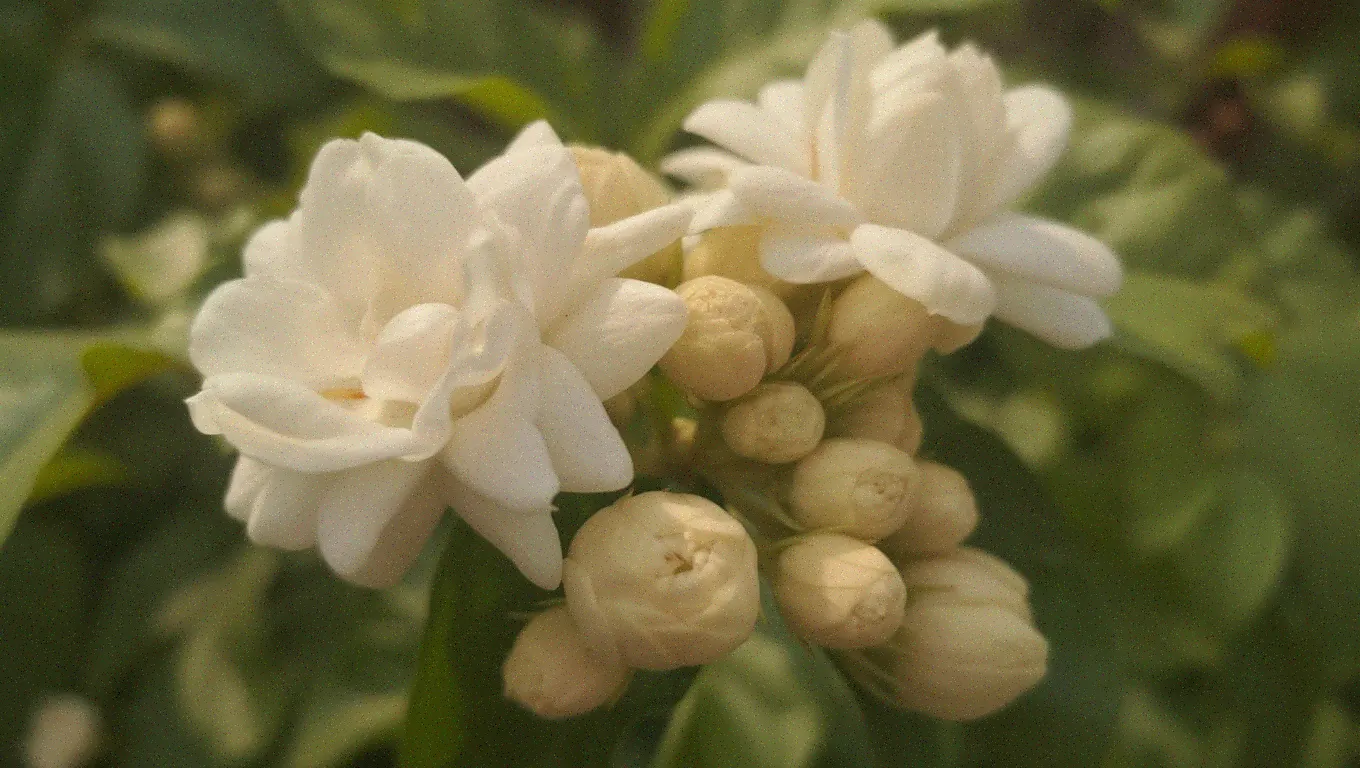
The Molecular Seduction of Jasmine: Chemistry, Indole, and the Art of White Floral Accords
Jasmine absolute stands alone among perfumery’s white florals—a material so complex that its 300+ molecules create a sensory experience that pure chemistry cannot replicate. The secret to its narcotic allure lies in an apparent contradiction: the same indole molecule responsible for the smell of decay becomes, at trace concentrations within jasmine’s molecular embrace, an essential component of floral seduction. This transformation from disgusting to beautiful represents one of perfumery’s most profound mysteries, and understanding it unlocks the art of creating compelling jasmine accords.
Natural jasmine absolute commands prices exceeding $15,000 per kilogram because each kilogram requires roughly 8 million hand-picked flowers, harvested at precise moments—dawn for Jasminum grandiflorum, midnight for the night-blooming J. sambac. Yet modern perfumery rarely uses jasmine alone. Instead, perfumers employ sophisticated synthetic accords that capture jasmine’s character while navigating regulatory restrictions and cost constraints. This report explores the chemistry underlying both approaches.
Two jasmines, two personalities: the royal versus the queen of night
The perfumer’s palette offers two primary jasmine species, each with a distinct molecular signature and olfactory personality. Jasminum grandiflorum—the royal jasmine of Grasse, Egypt, and India—delivers the classic French perfumery character: opulent, sweet, and brazenly fruity with apricot and banana undertones. J. sambac, the Arabian jasmine that opens its petals only after dark, offers something greener, headier, and more animalic—the jasmine of tea ceremonies and wedding garlands.
The chemical differences are striking. Grandiflorum absolute contains benzyl acetate at 15-67%, creating that distinctive fruity-floral sweetness, while sambac typically shows only 10-25%. Conversely, sambac’s indole content reaches 1-8% versus grandiflorum’s relatively modest 2.5%, explaining its heavier, more narcotic character. Perhaps most telling: grandiflorum contains 20-25% benzyl benzoate as a fixative base, while sambac shows less than 1%.
Organoleptic architecture of natural jasmine
The complete sensory profile unfolds in three movements:
Top notes arrive as sweet, fruity benzyl acetate—a flash of tropical fruit and fresh-cut pear. Linalool (8-20%) contributes citrus-floral brightness. In sambac, pronounced green notes from cis-3-hexenol esters create a vegetal, almost banana-peel opening.
Heart notes reveal jasmine’s true complexity: intensely floral warmth, honey-like sweetness, and a tea-like undertone particularly prominent in sambac. Methyl anthranilate (variable, up to 7.6% in sambac) introduces grape and orange blossom facets. The characteristic jasmine ketone, cis-jasmone at 2.6-3.4%, provides the unmistakable jasmine signature.
Base notes expose the narcotic, animalic soul—indole’s mothball-adjacent warmth, para-cresol’s hint of horse sweat, and the balsamic persistence of benzyl benzoate. These elements create what perfumers describe as jasmine’s “alive” quality.
What makes jasmine unique among white florals
Other white flowers share jasmine’s indolic character—tuberose, gardenia, orange blossom—but none achieves jasmine’s particular balance. Tuberose leans milky and coconut-lactonic with camphor facets. Gardenia trends green and mushroomy. Orange blossom carries a citrus innocence. Jasmine alone achieves the precise equilibrium between fruity sweetness (benzyl acetate), floral radiance (linalool), and narcotic depth (indole plus para-cresol) that creates its legendary sensuality. For comprehensive exploration of tuberose’s unique lactonic-indolic character and professional reconstruction techniques, see our guide on tuberose absolute and modern synthetics.
The indole paradox: from decay to desire
Indole (C₈H₇N) presents perfumery with its most elegant contradiction. In concentrated form—particularly above 1%—the molecule delivers an aggressive, fecal-naphthalenic assault reminiscent of mothballs and decay. Yet diluted below 0.1%, or embedded within jasmine’s complex matrix, indole transforms into something entirely different: a brilliant, radiant floral note that seems to make white flowers breathe and shimmer.
This is not metaphor but measurable reality. Fresh jasmine flowers emit indole at parts-per-million concentrations in air—always below the fecal perception threshold. The same molecule that would repel in concentration becomes, at these trace levels, an essential component of floral attraction.
The science of concentration-dependent perception
The transformation is primarily perceptual, not chemical. Indole remains chemically identical at all concentrations; what changes is how we perceive it.
Three mechanisms converge:
Weber-Fechner non-linearity governs olfactory intensity: subjective sensation scales logarithmically with concentration. A tenfold increase in indole concentration produces far less than tenfold perceived intensity—but the qualitative character can shift dramatically as different perceptual thresholds are crossed.
Olfactory receptor dynamics likely play a role. Research has identified specific indole-responsive receptors (Olfr205 and the Olfr740 family) in mammals, with distinct binding mechanisms at different concentration ranges. At low concentrations, these receptors may respond narrowly to indole’s floral facets; at high concentrations, additional receptor populations associated with warning odors may recruit.
Contextual integration completes the transformation. Within jasmine’s 300+ volatile compounds, indole becomes one voice in a chorus rather than a soloist. Benzyl acetate’s dominant fruity-floral character (at 15-67% versus indole’s 2.5%) provides perceptual masking. The brain integrates these signals into a unified form rather than parsing individual molecules.
Synergistic modulation within jasmine
The ratio matters profoundly. Natural jasmine contains roughly 200:1 benzyl acetate to indole. At this ratio, the fruity ester overwhelms indole’s negative facets while indole contributes depth without announcing itself. Each major constituent plays a role:
- Benzyl acetate (15-67%): Primary masking agent; its sweet fruity-floral character softens and contextualizes indole
- Linalool (8-20%): Provides brightness and citrus-floral lift; counteracts heaviness
- Methyl anthranilate (up to 7.6% in sambac): Creates “narcotic animalic background” alongside indole—both contributing white floral headiness
- Benzyl benzoate (10-25%): Rounds edges as a fixative; adds balsamic warmth
- cis-Jasmone (2.6-3.4%): The characteristic jasmine ketone that defines species identity
The critical insight: these components do not chemically react with indole—they modify perception of it through blending, masking, and contextual integration.
Indolene: the Schiff base that solves the indole problem
If concentration and context transform indole’s perception, chemistry offers another solution: chemically binding indole into a larger molecule that releases it only gradually. Indolene (IFF), also known as Indolall or Indolam 50, exemplifies this approach—a Schiff base formed between indole and hydroxycitronellal that creates jasmine character where neither parent molecule possesses it alone.
The chemistry of molecular transformation
The reaction follows classic Schiff base formation: hydroxycitronellal’s aldehyde carbon undergoes nucleophilic attack by indole’s nitrogen, forming an intermediate hemiaminal that loses water to create the stable C=N imine bond. The resulting molecule—(E)-8-indol-1-yl-2,6-dimethyloct-7-en-2-ol (CAS 68527-79-7)—has molecular weight 271 versus indole’s 117, dramatically reducing volatility.
Technically, because indole is a secondary amine, the product is technically an aminal rather than a true Schiff base (which forms with primary amines). This distinction matters chemically but not practically—the perfumery effect functions identically.
An emergent jasmine character
Here lies the transformation’s mystery: neither parent compound smells of jasmine. Indole delivers naphthalenic mothball notes at working concentrations. Hydroxycitronellal offers delicate lily-of-the-valley muguet character. Yet their Schiff base creates an authentic jasmine-orange blossom accord with soft animalic depth.
Several mechanisms explain this emergence:
The nitrogen binding locks indole’s most volatile, aggressive character. The molecule cannot deliver its initial naphthalenic assault because the nitrogen—source of that volatility—is chemically occupied.
The increased molecular weight (from 117 to 271) reduces vapor pressure by orders of magnitude, ensuring slow, controlled release rather than explosive initial impact. This mimics how natural jasmine presents indole: always at trace airborne concentrations, never the concentrated assault of neat material.
The gradual hydrolysis that occurs at skin temperature and in the presence of moisture slowly liberates both indole and hydroxycitronellal—but always at sub-threshold fecal concentrations. The nose receives them pre-diluted, as nature intended.
Finally, olfactory synergy emerges when the muguet-floral character of hydroxycitronellal contextualizes the liberated indole, creating a new sensory experience greater than the sum of components.
Technical specifications
Indolene presents as an intensely yellow to amber viscous liquid, typically sold at 50% dilution in DEP or benzyl benzoate for pourability. Its tenacity is exceptional—over 300 hours on a smelling strip—making it valuable both for jasmine character and fixation. IFRA permits up to 3.3% in finished fine fragrance (Category 4), though typical usage runs 1-10% of the perfume compound itself.
The synthetic jasmine palette: materials that build accords
Modern jasmine accords rarely rely on absolute alone. Instead, perfumers combine naturals with sophisticated synthetics that provide radiance, longevity, cost efficiency, and regulatory compliance. Several materials form the essential vocabulary.
Hedione: the revolutionary radiance molecule
Hedione (IFF, CAS 24851-98-7, also known as Methyl Dihydrojasmonate) represents one of perfumery’s most impactful synthetics. Discovered in 1966, this molecule captures the airy, radiant top and middle notes of jasmine without jasmine’s indolic weight. At 15-20% of a jasmine accord, Hedione provides the “lift” and diffusion that makes jasmine sing in a room rather than whisper on skin alone.
Hedione’s magic lies in its molecular simplicity. Unlike benzyl acetate’s fruity-floral character, Hedione delivers a crystalline, green-tinged floral radiance—imagine the smell of white petals in sunlight, stripped of indolic weight. It pairs beautifully with indole and Indolene, cutting their heaviness while maintaining their seductive depth. IFRA imposes no restrictions on Hedione, making it a regulatory safe harbor.
Benzyl acetate: the foundation stone
Benzyl acetate (CAS 140-11-4) anchors every jasmine accord. This ester delivers the fruity-floral sweetness—tropical fruit, pear, apricot—that defines grandiflorum jasmine’s character. At 25-35% of a jasmine accord, benzyl acetate provides the dominant sensory character and masks indole’s aggressive facets through sheer concentration and perceptual dominance. Its cost-effectiveness, safety profile, and regulatory freedom make it indispensable.
Linalool and linalyl acetate: brightness and lift
Linalool (the laevo isomer preferred in perfumery, CAS 78-70-6) and its acetate ester (linalyl acetate, CAS 115-95-7) contribute the citrus-floral brightness that prevents jasmine accords from becoming cloying. Linalool introduces green, bergamot-like freshness; linalyl acetate adds creamy, slightly waxy florality. Together at 8-15% of the accord, they provide the top-note sparkle and prevent the composition from dwelling solely in narcotic, indolic space.
Phenylethyl alcohol and methyl anthranilate: the floral anchors
Phenylethyl alcohol (CAS 60-12-8) provides the rose-like floral body that grounds jasmine accords in warmth. Unlike jasmine’s fruity, citrus-tinged character, phenylethyl alcohol delivers a denser, more animalic floral note—honey, rose petals, skin musk. At 3-8% of the accord, it prevents jasmine from reading as purely fresh and tropical.
Methyl anthranilate (CAS 134-20-3, also called methyl 2-aminobenzoate) introduces the characteristic grape and orange blossom facet. In sambac jasmine, methyl anthranilate reaches 7.6%, creating the headiness perfumers call “narcotic animalic.” At 2-5% of a synthetic accord, it echoes sambac’s character and adds dimensionality without requiring natural jasmine absolute.
Benzyl benzoate and para-cresyl acetate: the fixative animalics
Benzyl benzoate (CAS 120-51-4) functions primarily as a fixative base, adding balsamic warmth and tenacity. Unlike the fruity benzyl acetate, benzyl benzoate’s ester linkage between two aromatic groups creates a denser, more persistent character—imagine soft leather, vanilla, warm amber. At 5-10% of the accord, it provides depth and staying power.
Para-cresyl acetate (also called p-cresyl acetate, CAS 588-24-9) ranks among perfumery’s most restricted materials due to sensitization concerns—IFRA limits it to 0.005% in finished fine fragrance. Yet at trace levels, this material delivers the animalic “horse sweat” note that gives jasmine its seductive, slightly dangerous character. When blended with indole and methyl anthranilate in a jasmine accord, para-cresyl acetate reinforces the “alive” quality that distinguishes compelling white florals from flat synthetics.
IFRA compliance for jasmine materials
Regulatory restrictions significantly impact modern jasmine formulation, particularly for natural absolutes.
| Material | IFRA Cat. 4 Limit (Fine Fragrance) | Notes |
|---|---|---|
| J. grandiflorum absolute | 0.6% in finished product | Severely restricted; sensitization |
| J. sambac absolute | 3.8% in finished product | Less restricted |
| Indolene | 3.3% | Based on hydroxycitronellal release |
| Hedione | No restriction | Safe at any level |
| Benzyl acetate | No restriction | Foundation material |
| Para-cresol | 0.005% | Extremely restricted |
| Alpha-amylcinnamaldehyde | EU allergen declaration | >0.001% requires labeling |
These limits apply to finished consumer products, not perfume concentrates. A fragrance at 15% concentration in an EdP has significantly more headroom than the raw limit suggests.
A modern jasmine absolute accord: the formula
The following formula reconstructs natural jasmine absolute character—fresh floral opening over deep animalic base—using IFRA-compliant materials at professional concentrations. Total: 100 parts.
Top and heart structure (82 parts)
Benzyl acetate.................................. 28.0
Fruity-floral jasmine foundation
Hedione......................................... 18.0
Radiance, diffusion, airy lift
Linalool (laevo)................................ 12.0
Fresh citrus-floral top
Hedione HC...................................... 6.0
Dense floral heart enhancement
Phenylethyl alcohol............................. 5.0
Rose-like body, floral support
Benzyl alcohol.................................. 4.0
Sweet floral softness
Methyl anthranilate (50% in BB)................. 3.0
Orange blossom facet
Linalyl acetate................................. 3.0
Fresh bergamot-like lift
Styrallyl acetate............................... 2.0
Green-gardenia freshness
Cis-3-hexenyl salicylate........................ 1.0
Green-balsamic naturalness
                                                 ---
                                                 82.0
Indolic and animalic heart (8 parts)
Indolene (50% in DEP).......................... 4.0
Jasmine-orange blossom via Schiff base
Indole (10% in DPG)............................ 2.5
Radiant floral depth, narcotic quality
Para-cresyl acetate (10% in DPG)............... 1.5
Animalic warmth, narcissus facet
                                                ---
                                                8.0
Base and fixation (10 parts)
Benzyl benzoate................................ 5.0
Balsamic fixative, softness
Hexyl cinnamic aldehyde........................ 3.0
Sweet fixation, body
Jasmolactone................................... 1.0
Creamy lactonic depth
Benzyl salicylate.............................. 1.0
Soft floral fixation
                                                ---
                                                10.0
----
TOTAL.......................................... 100.0Usage guidance
This accord functions as a building block, not a finished fragrance:
- As dominant floral (jasmine-forward composition): 15-25% of perfume concentrate
- As supporting floral (part of floral bouquet): 8-15% of concentrate
- As accent note (jasmine touch in non-floral): 3-8% of concentrate
For a finished Eau de Parfum at 15% fragrance concentration:
- Accord at 20% of concentrate = 3% of finished product
- Well within IFRA compliance for all materials
Optional enhancements
- For greater naturalism: Add 0.5-2% jasmine sambac absolute (within IFRA limits)
- For enhanced indolic depth: Increase Indole 10% to 4 parts; add Skatole 1% at 0.2 parts
- For green freshness: Increase cis-3-hexenyl salicylate to 2 parts
- For orange blossom facet: Increase methyl anthranilate to 5 parts
The transformation principle in practice
This formula embodies the indole paradox’s resolution. Pure indole at 2.5% of formula would deliver aggressive mothball notes. But presented as:
- 0.25% actual indole (from 10% dilution)
- Plus ~2% controlled-release indole (from Indolene’s gradual hydrolysis)
- Within a matrix dominated by benzyl acetate (28%)
…the indole contributes exactly what natural jasmine provides: radiant floral depth, narcotic warmth, and the ineffable “alive” quality that distinguishes compelling white florals from flat synthetic arrangements.
The Schiff base strategy (Indolene) proves particularly elegant: it packages indole in a form that releases slowly at the skin, mimicking how living jasmine flowers present indole to the air—always at seductive trace concentrations, never the overwhelming assault of concentrated material.
Conclusion: mastering the molecular seduction
Jasmine absolute’s unique status in perfumery derives from its resolution of apparent contradictions—indole’s fecal character becoming floral radiance, hundreds of volatile components creating unified sensory experience, the boundary between attractive and repulsive proving far more permeable than expected. Understanding these transformations—concentration-dependent perception, contextual modulation, chemical binding through Schiff bases—provides the perfumer with tools for creating jasmine accords that capture the absolute’s character without its limitations.
The formula presented here demonstrates that modern synthetic jasmine need not be a pale imitation of the natural. By incorporating the indolic transformation principle (indole plus Indolene for controlled delivery), balancing fruity-fresh top notes against animalic-narcotic depth, and respecting IFRA constraints while maximizing expressive range, perfumers can create accords worthy of jasmine’s legendary status—the flower that earned its place at the heart of perfumery’s most seductive compositions.


Pingback: The Art of Narcotic Florals: Tuberose Absolute, Modern Synthetics, and Accord Construction - olfactive aesthetics author's niche perfumery
February 12, 2026
Pingback: Gardenia absolute: capturing the ephemeral white queen - olfactive aesthetics author's niche perfumery
March 20, 2026